Feet Pics Price List for 2026 (Start Here)
You came here asking how much to charge for feet pics, so let's not make you scroll for it. Most guides bury the numbers under ten paragraphs of history; we'll do the opposite — numbers now, reasoning after.
One promise before the table: everything here comes from observable prices on live marketplaces and consistent seller reports in 2026, not from a course seller's fantasy. Where ranges are wide, we say so and explain what moves you inside them. And where honest sellers disagree — like the exact floor for customs — we give you the safer number.
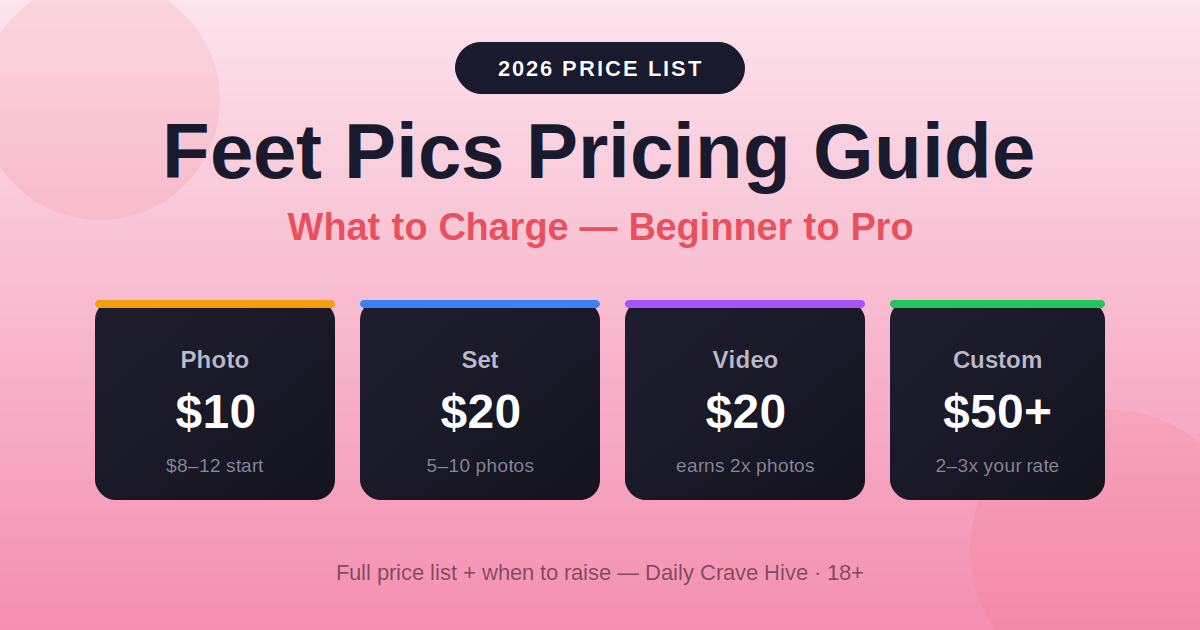
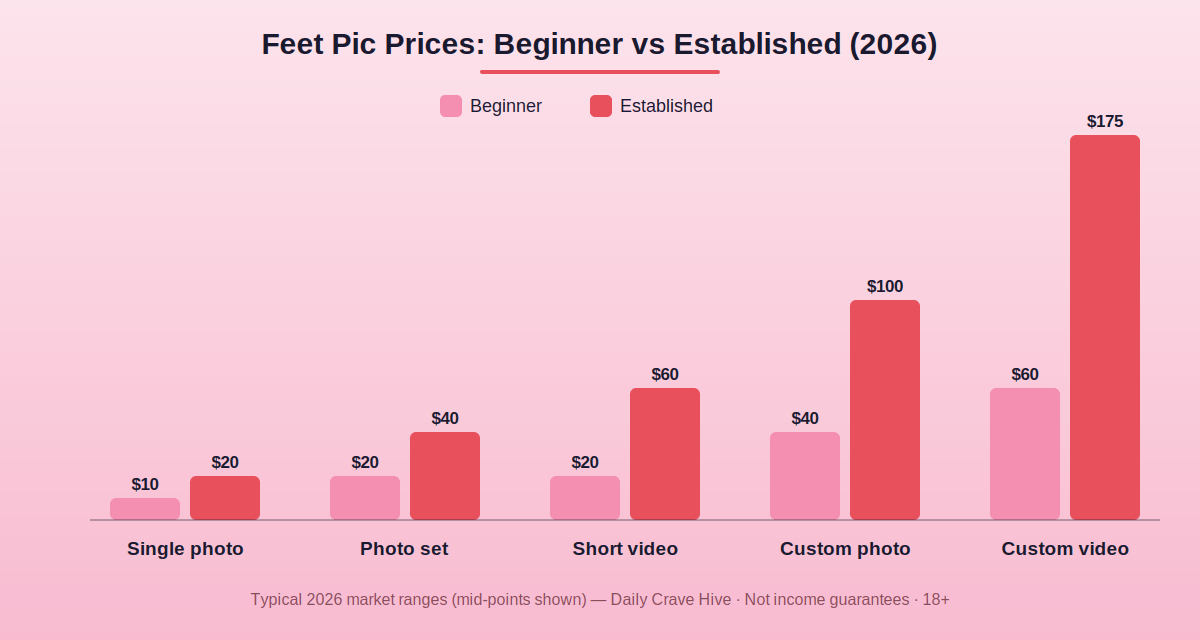
Here's the working price list for 2026 — the same ranges active sellers use on real marketplaces today:
| What you're selling | Beginner price | Established price |
|---|---|---|
| Single photo | $8–$12 | $15–$25 |
| Photo set (5–10 pics, one theme) | $15–$25 | $30–$50 |
| Short video (15–60 seconds) | $15–$25 | $40–$75 |
| Custom photo (their request) | $25–$50 | $60–$150+ |
| Custom video | $40–$80 | $100–$250+ |
| Subscription (fan platforms) | $5–$10/month | $10–$15/month + paid extras |
If you only remember three numbers from this whole guide, remember these: $10 for a photo, $20 for a set, $50 for a custom. That trio is a safe, sane starting point almost anywhere.
But a price list without the thinking behind it is fragile — the first lowball buyer will talk you out of it, and the first slow week will make you panic-drop everything to $3.
The rest of this guide gives you the reasoning, so your prices survive contact with real buyers. That's the part most sellers never get, and it's exactly why so many stay stuck at $5 forever.
The Three Rules Behind Every Price on That List
Feet pic pricing looks random from outside. It isn't. Three rules produce every number above:
Rule 1 — Price signals quality. Buyers can't touch or test what they're buying, so price is information. A $3 photo whispers "low effort, maybe a scam." A $12 photo says "this person takes it seriously." Cheap doesn't just cost you money per sale — it costs you the sale itself, because serious buyers scroll past bargain bins.
This is the single hardest thing for beginners to believe, and the single most profitable.
Rule 2 — Customs carry the business. Standard photos are your storefront window; custom requests are the cash register. A custom buyer isn't paying for a picture — they're paying for their idea, made for them, and personalization always commands multiples.
That's why customs sit at 2–3× your standard rate minimum, and why every seller who crosses $500/month has a custom pipeline. (Our earnings breakdown shows this math across a full month.)
Rule 3 — Raise on proof, not on hope. You don't raise prices because a month passed. You raise them when the market hands you evidence: reviews stacking up, repeat buyers returning, customs arriving without you chasing.
Each proof signal supports the next step up the ladder. Pricing this way means you're never guessing — you're responding.
Keep these three in your head and you can price anything in this niche, including situations no guide covers.
How Much to Charge for Feet Pics: Quick Answers by Situation
Different sellers arrive at this question from different places. Find your row:
"I'm brand new and have zero reviews." Charge $8–$12 per photo anyway. New sellers assume they must earn the right to normal prices — they don't. Buyers can't see your account age as loudly as they can see your price, and a $3 tag hurts you more than an empty review section does. Start normal, let reviews catch up.
"I have a small following on Instagram or TikTok already." Start one notch higher — $12–$15 singles — because you're arriving with social proof and your own traffic. An audience, even a small one, is pricing leverage from day one.
"I only want to sell casually, a few pics a month." Same prices as everyone else. Casual sellers often price low "because it's just for fun," which only means working the same amount for less. Volume is optional; underpricing is not a substitute for it.
"A buyer already messaged me asking my price." Quote your standard rate confidently — "$12 per photo, sets from $20, customs from $40" — and stop typing. The first number you say anchors the whole conversation, so make it your real price, not a nervous discount.
"I'm asking how much to charge for feet pics because someone offered me $100 out of nowhere." Careful — unsolicited big offers are the classic opening of overpayment and chargeback scams, not generosity. Real buyers ask questions and pay normal market rates through the platform.
Whatever your situation, notice the theme: the answer is never "lower." Now let's price each content type properly.
Pricing Each Content Type (And Why They Differ)
Now the reasoning behind each row of the price list, one by one, in the order you'll actually sell them.
Single photos: your entry point, not your income
Singles exist for two jobs: letting new buyers test you cheaply, and catching impulse purchases. Price them at $8–$12 as a beginner — high enough to signal quality (Rule 1), low enough to be an easy first yes.
What singles are not is your income plan. Twenty single sales is twenty separate buyers found, convinced and served for about $200. You'll see why that's the hard way in a moment.
One practical trick: keep one or two singles at the bottom of your range ($8) deliberately as "tester" items, and let everything else sit higher. The tester converts a stranger into a customer; your catalog upsells them from there.
Photo sets: where the volume money is
A themed set of 5–10 photos (same concept, multiple angles) prices at $15–$25 for beginners — roughly 60–70% of what the photos would cost individually. The discount is real for the buyer, and the economics are better for you: one transaction, one delivery, triple the revenue of a single.
Sets also do quiet marketing work. A buyer who liked one photo but wasn't sure about spending again gets an obvious next step: "the full set is $20." You're not finding a new buyer — you're deepening one you already have, which is always cheaper.
Theme ideas that consistently sell as sets — beach, stockings, oil/shine, polish colors, seasonal — are covered with a full shot list in our feet pic photo guide.
Videos: the easiest 2× in the niche
Here's a number that surprises new sellers: video reliably earns about double what photos do, for barely more effort. A 30-second clip — walking, stretching, applying lotion, polish close-ups — prices at $15–$25 as a beginner and climbs fast with reviews.
Why the premium? Motion feels more personal and more scarce. Most sellers are photo-only, so video sellers stand out in every marketplace search. If you're wondering how much to charge for feet pics and videos together as bundles: photo set + related clip at about 80% of their combined price is a proven combo that lifts average order size.
If you add exactly one thing to your catalog after reading this guide, make it three short videos. It's the highest-return upgrade available to a beginner.
Custom requests: the real business
Everything above is retail. Customs are commissions — and they're priced completely differently, because the buyer isn't purchasing content, they're purchasing attention.
How much to charge for custom feet pics: start at 2–3× your standard rate as the floor — so if your photos are $12, customs start at $25–$35, and custom videos at $40–$80. Established sellers routinely charge $100+ for involved custom videos, and the demand is real.
Custom pricing rules that protect you:
- Quote after they describe the request, never before. "Depends on the request — tell me what you have in mind" keeps you from underquoting complex asks.
- Complexity multiplies the price. Specific outfits, props, longer videos, fast delivery — each adds. A rush request is +50% minimum.
- Payment first. Always. No exceptions. This is both a pricing rule and a safety rule — every custom scam starts with "I'll pay after I see it."
- Say no cheerfully. A lowball custom offer isn't an insult, it's a filter working. "My customs start at $40" ends the conversation or starts the sale — both outcomes are wins.
Subscriptions: different model, different math
On fan platforms (Fansly, Fanvue, OnlyFans and the like), the subscription isn't really the product — it's the door charge. Price it accessibly at $5–$10/month and earn the real money inside: tips, paid messages, PPV drops, and customs sold in DMs.
New sellers get this backwards, setting $25 subscriptions that nobody takes a chance on. A $7 subscription with active paid messaging out-earns a $25 subscription with silence — because the door was low enough for fans to walk through. Platform-by-platform breakdowns of these tools live in our OnlyFans alternatives comparison.
How Much to Charge for Feet Pics on OnlyFans (And Other Fan Platforms)
This question gets its own section because the answer genuinely differs from marketplaces:
- Subscription: $5–$10/month to start. Raise only after you have retention data — subscribers who stay 3+ months.
- PPV messages: $5–$15 for photo drops, $10–$30 for video drops, sent to all subscribers. This is usually the biggest single income line on the platform.
- Tips: don't price these — prompt them. "Tip $10 and I'll send the extended cut" turns passive fans into active spenders.
- Customs via DM: same 2–3× rule as everywhere, same payment-first rule, arranged through the platform's paid message system so you stay protected.
The key mental shift: on OnlyFans you're pricing a relationship funnel, not individual items. Cheap entry, monetized middle, premium top. Marketplaces sell items; fan platforms sell access with items inside. Sellers who price both the same way leave money on whichever platform they misunderstood.
One more OnlyFans-specific note: the platform caps subscriptions at $49.99 and takes 20% of everything, same as its main rivals — the fee math between platforms is nearly identical, so pick platforms on audience and features, not on decimal points of commission.
Five Things That Change What You Can Charge
The price list gives you the market's ranges. These five factors decide where you sit inside them — and they're worth checking honestly before you pick your numbers:
1. Content quality and variety. Sharp, well-lit photos with real variety support the top of every range; blurry phone snaps in bad light don't. The gap between the two is mostly technique, not equipment — a window, a $15 tripod and the shot list in our photo guide move you up a tier for almost nothing.
2. Niche and theme depth. Sellers who own a specific lane — a polish aesthetic, an outfit style, a consistent theme — charge more than generic catalogs, because their buyers can't get "that exact thing" elsewhere. Specific beats general in pricing power, always.
3. Response speed and professionalism. Buyers pay premiums to sellers who reply within hours, deliver on time, and communicate clearly. It sounds soft; it's measurable. Fast, professional sellers win customs at prices slow sellers never see, because customs are trust purchases.
4. Where you sell. A marketplace full of intent buyers supports better prices than a random DM on social media. Platform choice is quietly a pricing decision — the rankings in our best platforms guide matter for your rates, not just your traffic.
5. Video in the catalog. Photo-only sellers compete with everyone; photo-and-video sellers compete with far fewer. Just having clips available raises what buyers expect to pay you across the board, because it signals a serious operation.
None of these require talent you don't have — they're all buildable in weeks. Which is another way of saying: your position on the price ladder is a decision, not a diagnosis.
What Reddit Says About Feet Pic Pricing (The Honest Summary)
People search "how much to charge for feet pics reddit" for a good reason: they want unfiltered answers from real sellers, not marketing. Having read through the community discussions, here's the honest synthesis:
- The consensus range matches this guide. Experienced sellers on Reddit repeatedly land on $5–$25 for standard photos and 2–3× for customs — with the strong advice to start closer to $10 than $5.
- The most-repeated warning: don't underprice. The community is blunt that $1–$3 sellers attract time-wasters and scammers, not volume. Multiple long-time sellers describe raising prices and gaining buyers.
- The most-repeated reality check: pricing isn't the bottleneck. Reddit threads are full of perfectly-priced empty shops. Sellers consistently say promotion and consistency decide income far more than the exact number on the tag — which matches everything in our earnings guide.
- A caution about Reddit itself: advice there skews toward whoever posts loudest, sample sizes are tiny, and some "advice" comes from sellers marketing their own coaching. Take the patterns, skip the hot takes.
The Price Ladder: When (Exactly) to Raise
The beginner-to-pro journey isn't one price decision — it's a series of small raises, each triggered by proof. Here's the ladder with its triggers:
Stage 1 — Launch (weeks 1–4): Singles $8–$12, sets ~$20, customs from $25. Goal isn't profit yet — it's first sales and first reviews. Resist pricing lower "to get started"; Rule 1 doesn't pause for beginners.
Stage 2 — First proof (after 5–10 positive reviews): Raise everything 10–20%. Singles to $10–$15, sets to $25, customs from $35. Reviews are public proof of quality — your prices should reflect what buyers can now verify.
Stage 3 — Repeat buyers (months 2–4): When the same names return, raise another 15–20% and introduce bundles (set + video). Returning buyers barely notice raises — they're buying you now, not a price.
Stage 4 — Custom demand (months 3–6): When custom requests arrive weekly without prompting, your customs are underpriced. Raise custom floors 25–50%. Demand you didn't chase is the market telling you the price is wrong — in your favor.
Stage 5 — Pro (6+ months): Singles $15–$25, sets $30–$50, customs $60–$150+, video customs into the hundreds. At this stage you're also pruning: fewer cheap items, more premium ones, and possibly a subscription platform running alongside.
The pattern across all five stages: the market raises your prices for you — your only job is to notice the signals and not chicken out. Anyone still wondering how much to charge for feet pics six months in usually isn't missing information — they're sitting on Stage 2 proof while charging Stage 1 prices.
A Simple Formula to Set Any Price
For anything this guide didn't cover, price it in four questions:
- What's my current base? (Your single-photo price — say $12.)
- How much more work is this than one photo? Multiply. (A 10-photo set ≈ 3× work priced at ~2× for the bundle discount = $25.)
- Is it personalized? If yes, multiply by 2–3. (Custom set = $50–$75.)
- Is it urgent or unusually specific? Add 25–50%.
Base × effort × personalization × urgency. Every number in this pricing guide comes out of that little machine, and so will every price you'll ever need to invent on the spot when a buyer asks for something new.
What You Actually Keep: Fees Change Your Real Price
A quick reality layer, because your price and your income are different numbers:
| Where you sell | Typical platform cut | You keep from a $20 sale |
|---|---|---|
| Major fan platforms (OnlyFans, Fansly, Fanvue) | ~20% | ~$16 |
| Feet marketplaces (FeetFinder, Fun With Feet) | Commission and/or seller subscription — varies | Check each platform's current fees |
Two takeaways: first, always confirm live fees inside the app before relying on them — platforms change terms quietly (our FeetFinder review and Fun With Feet review break down current fee structures). Second, don't obsess over a few percentage points of commission — a platform with real buyers at 20% beats an empty platform at 10% every single time. Fees matter; buyers matter more.
And the number that outranks both: taxes. This is self-employment income, it's taxable, and setting aside 20–30% from your first dollar is the least glamorous, most adult pricing decision you'll make.
Six Pricing Mistakes That Keep Sellers Broke
- Racing to the bottom. Pricing at $2 because "somebody sells at $3" — you're not competing with the cheapest seller; you're differentiating from them (Rule 1, forever).
- Never raising. Six months, forty reviews, same launch prices. The ladder exists to be climbed.
- Quoting customs before hearing the request. Instant underpricing on anything complex.
- Negotiating against yourself. A buyer goes quiet and you drop the price unasked. Silence is not a counteroffer — wait, or move on.
- Confusing subscriptions with the product. Pricing a $25 door on a fan platform and wondering where the fans went.
- Delivering before payment. Not strictly a pricing mistake — a survival one. Free previews are marketing; free customs are theft you volunteered for.
If you've made a few already: welcome to the club, everyone has. Fix them this week; the market has no memory for reformed underpricers.
Scripts: What to Say When Buyers Push Back
Prices only work if you can hold them in a live conversation. Here are the four situations every seller faces, with words that keep your price and your buyer:
"That's too expensive." Reply: "That's my rate — it covers the quality you see in my previews. The $20 set is the best value if budget matters." You didn't drop the price; you redirected to a cheaper product. Half the time they buy the set. The other half weren't buying anyway.
"Can you do $5? Other sellers charge that." Reply: "The sellers at $5 are the reason buyers get burned — my prices are where they are because the content is real and delivered every time. Customs start at $40 when you're ready." Polite, firm, and it reframes your price as their safety. Never match the bottom.
"I'll pay after you send it, promise." Reply: "Payment first, always — that's how I work with everyone. The moment it clears, your content is on its way." No exceptions, no matter how friendly the conversation has been. This one isn't negotiation; it's the scam filter doing its job.
Silence after you quote. Reply: nothing, for 24 hours. Then one follow-up: "Still interested? Happy to answer any questions." What you never do is chase silence with a discount — that teaches every future buyer that going quiet earns 20% off.
Practice these four and pricing pressure mostly disappears. Buyers push exactly as hard as sellers bend — hold once, and most stop pushing.
Set Your Prices Today: The 15-Minute Checklist
Close this guide with prices actually set — here's the whole thing as a do-it-now list:
- Set singles at $10 (or $8–$12 based on your confidence).
- Build one themed set, price it at $20.
- Record three short clips, price at $15–$20 each.
- Write your custom line: "Customs start at $40 (video from $60) — tell me what you have in mind."
- If you're on a fan platform, set the subscription at $7–$9 and plan your first PPV drop.
- Write your price list in your bio/profile so you never negotiate from zero.
- Calendar reminder for 30 days: check reviews and repeat buyers — if the proof is there, take Stage 2's raise.
That's a complete, defensible pricing setup in fifteen minutes — and a better answer to how much to charge for feet pics than any single number could be, because now you own the reasoning, not just the tag.
The Bottom Line on Pricing
Three ideas carry this entire guide. Price signals quality, so cheap costs you buyers, not just margin. Customs are the business, so build the pipeline and protect it with payment-first. And proof — reviews, repeat buyers, unprompted requests — is the only raise-trigger you need, arriving on its own schedule if you keep showing up.
Set the starter numbers today, hold them politely when tested, and let the ladder do its slow, reliable work. Six months from now the question won't be what to charge — it'll be how high the proof lets you go. That's a much better problem, and it's built one honest price at a time.
Frequently Asked Questions
How much should a beginner charge for feet pics?
Start at $8–$12 for single photos, $15–$25 for themed sets, $15–$25 for short videos, and $25–$50 for customs. These prices are high enough to signal quality (which actually helps sales) and low enough to convert first buyers. The one thing to avoid is pricing at $1–$5 — it attracts time-wasters instead of volume.
How much to charge for feet pics on OnlyFans?
Price the subscription low ($5–$10/month) as the entry point, then earn through PPV messages ($5–$15 for photos, $10–$30 for videos), tips, and customs at 2–3× your standard rates. On fan platforms the subscription is the door, not the product — most income happens in paid messages after fans join.
How much to charge for custom feet pics?
Start customs at 2–3× your standard price — if your photos are $12, customs begin at $25–$35 and custom videos at $40–$80. Quote only after hearing the full request, add 25–50% for rush or unusually specific asks, and always take payment before delivering. Established sellers charge $100+ for involved custom videos.
What's a good feet pics price list for 2026?
A working 2026 price list: singles $8–$15, themed sets $20–$30, short videos $15–$25, custom photos from $40, custom videos from $60, subscriptions $5–$10/month. Raise each tier 10–20% after every 5–10 positive reviews. Post the list in your profile so buyers see prices before they message.
Should I lower my prices if nothing is selling?
Almost never — slow sales are usually a traffic problem, not a price problem. A perfectly priced shop with no promotion sells nothing. Before touching prices, check: are you promoting daily, is your catalog varied (15+ items), are you answering messages fast? Fix those first; dropping to $3 just attracts bargain-hunters and signals low quality.
How much are feet pics with videos worth as a bundle?
Bundle a photo set with a related short video at about 80% of their combined separate price — for example, a $20 set plus a $20 clip bundles well at $32. Bundles raise your average order size and give hesitant buyers an obvious "best value" option. Video content alone typically earns about double what photos do.
When should I raise my feet pic prices?
Raise on proof, not on time: 10–20% after every 5–10 positive reviews, another raise when repeat buyers appear, and a 25–50% custom-price raise when custom requests start arriving weekly without prompting. Unprompted demand is the clearest signal your prices are below market.
Do higher prices really sell better than cheap ones?
Within reason, yes. Buyers can't inspect digital content before purchase, so price acts as a quality signal — $10–$15 photos routinely outsell $2–$3 photos because serious buyers avoid bargain-bin listings that look like scams or stolen content. Cheap pricing filters in time-wasters and filters out the buyers you want.
Alma MartinEditor, Daily Crave Hive
Alma Martin is the editor at Daily Crave Hive. She tests creator and adult platforms hands-on — fees, payouts, safety, and scam checks — so readers get honest reviews before they sign up. 18+.