🏆 Quick Answer
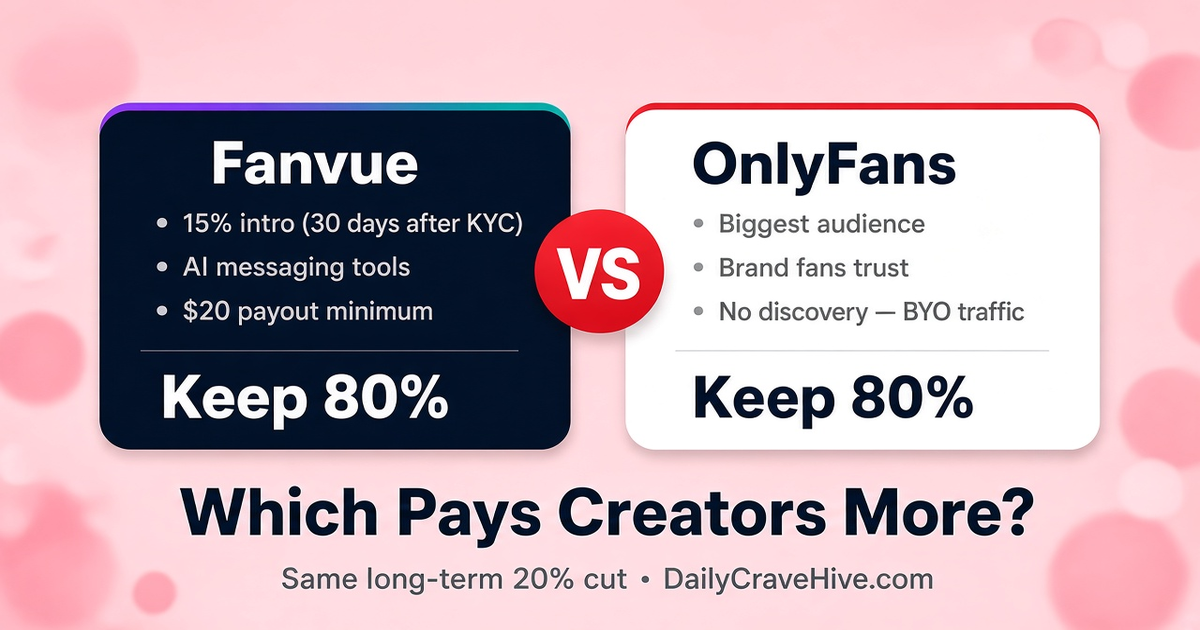
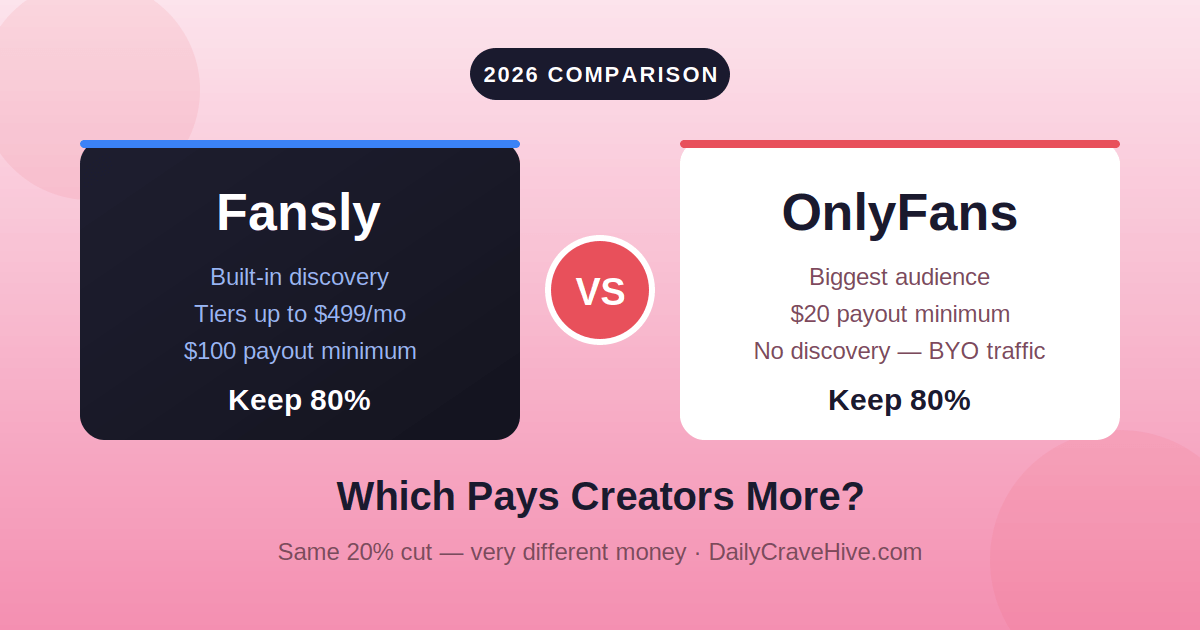
Neither platform pays a higher rate: both Fansly and OnlyFans take a 20% commission, so creators keep 80% of every subscription, tip, and pay-per-view sale on either platform. The real money differences hide elsewhere. OnlyFans has a far larger audience and more established payment infrastructure, which usually means more total income for creators who bring their own following.
Fansly offers built-in discovery (a For You page and search), multi-tier subscriptions up to $499/month, and quick payout processing — with a $20 minimum on most payout methods, though SEPA ($50) and wire or crypto ($100) cost more to unlock.
For most beginners, OnlyFans earns more overall; Fansly wins if you have no existing audience or your content gets restricted on OnlyFans. Many established creators simply run both.
In this comparison: the full fee breakdown, payout speed and minimums, subscription tier differences, audience and discovery, censorship policies, realistic earnings scenarios, and a verdict by creator type.
If you're planning to sell content in 2026, this is the first fork in the road: fansly vs onlyfans. Both dominate the subscription-content space, both take the same cut, and both get recommended constantly — usually by people who haven't looked at the details in two years.
Here's why this comparison matters more than most creators realize: the platforms charge identical fees but pay you very differently in practice. Payout minimums, processing speed, subscription caps, discovery, and content rules all change how much money actually reaches your bank account — and when.
We dug through both platforms' current terms, payout documentation, and creator reports to map exactly where the money differs in 2026.
Let's start with the platform most people know less about.
What Is Fansly? (And What Is It Used For?)
Fansly is a subscription-based content platform where fans pay creators directly through monthly subscriptions, tips, pay-per-view messages, and custom content requests. It launched in 2020 and grew rapidly in 2021 when OnlyFans briefly announced (then reversed) a ban on adult content — thousands of creators opened Fansly accounts as a backup, and many stayed.
Functionally, Fansly is used for the same thing as OnlyFans: monetizing content behind a paywall, most commonly adult content, but also fitness, cosplay, modeling, and lifestyle content. The core difference is philosophy. OnlyFans behaves like a payment tool — it processes subscriptions but does nothing to help fans find you.
**Fansly behaves more like a social platform — it has a For You page, search, and tagging, so fans can discover creators inside the app. ** If you already know OnlyFans, think of Fansly as: same business model, same 20% cut, smaller audience, better built-in tools.
For a full look at the platform, read our Fansly review.
Fansly vs OnlyFans: Quick Comparison Table
| Factor | OnlyFans | Fansly |
|---|---|---|
| Commission (the cut) | 20% — you keep 80% | 20% — you keep 80% |
| Payout minimum | $20 (commonly reported; OnlyFans' Terms give no figure) | $20 most methods ($50 SEPA, $100 wire/crypto) |
| Payout processing | 3–5 business days (after ~7-day hold) | Most requests approved within 48 hours, then typically 1–3 business days |
| Subscription price cap | $49.99/month, single tier | Up to $499/month, multiple tiers |
| Audience size | Hundreds of millions of users — the market leader | Much smaller, but growing |
| Built-in discovery | None — you bring your own traffic | For You page, search, tags |
| Content rules | Stricter; more restricted categories | More permissive within legal limits |
| Referral program | Limited-term | Lifetime referral earnings |
| Best for | Creators with an existing audience | Beginners with no audience; restricted niches |
Verify current terms on each platform's official pricing and payout pages before signing up — platforms update policies without much announcement.
Now let's unpack each row, because the table hides some important nuance.
The Fansly vs OnlyFans Cut: Fees Are Identical
Let's kill the biggest myth first. You'll see posts claiming one platform "pays better rates" — it's not true in 2026 and hasn't been for years.
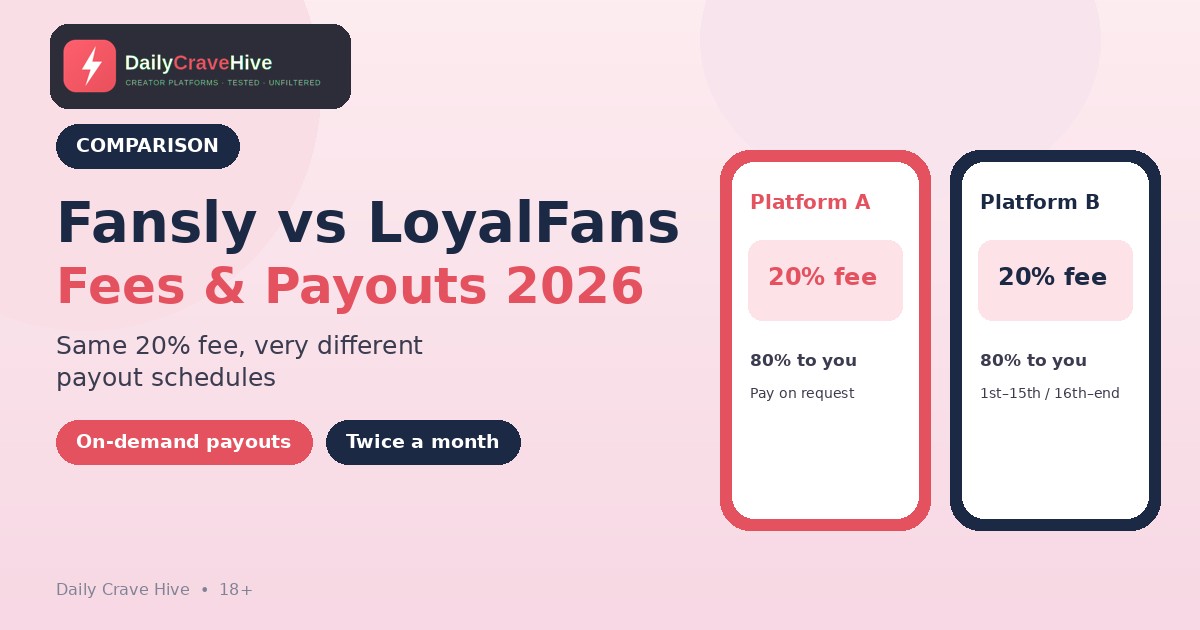
Both platforms take exactly 20% of everything you earn. Subscriptions, tips, pay-per-view messages, custom content — every revenue stream, same cut, on both platforms. Earn $100, keep $80. Neither platform offers volume discounts or tiered commissions; the rate is flat whether you make $100 or $100,000 a month.
So if the headline rate is identical, why does one platform routinely pay creators more in practice? Because commission percentage is only one of five factors that decide your real income:
- How many paying fans can actually find you (audience + discovery)
- How much you can charge (subscription caps and tiers)
- When you can access your money (payout minimums and speed)
- What content you're allowed to sell (censorship and restrictions)
- How reliably payments go through (processing infrastructure) The rest of this comparison walks through each one — and this is where the platforms genuinely split.
Payouts: Where New Creators Feel the Biggest Difference
This is the section most fansly vs onlyfans comparisons skip, and it's the one that hits beginners hardest.
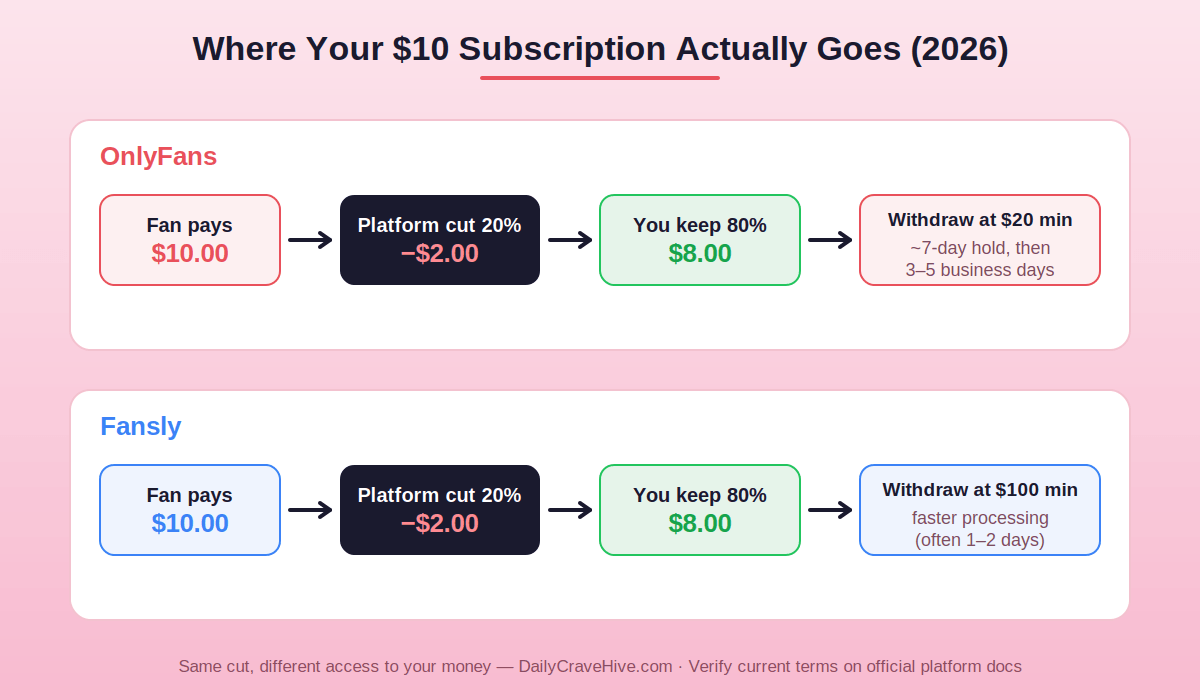
OnlyFans: OnlyFans' Terms say a minimum payout amount applies but don't give a figure; $20 is commonly reported. Earnings are typically held about 7 days after a transaction, then processed in 3–5 business days once you request withdrawal. OnlyFans also supports a wider range of payout methods through more established banking relationships, which in practice means fewer failed payments in most regions. For the full breakdown of the 20% cut, pending balance and withdrawal options, see our OnlyFans fees & payouts guide.
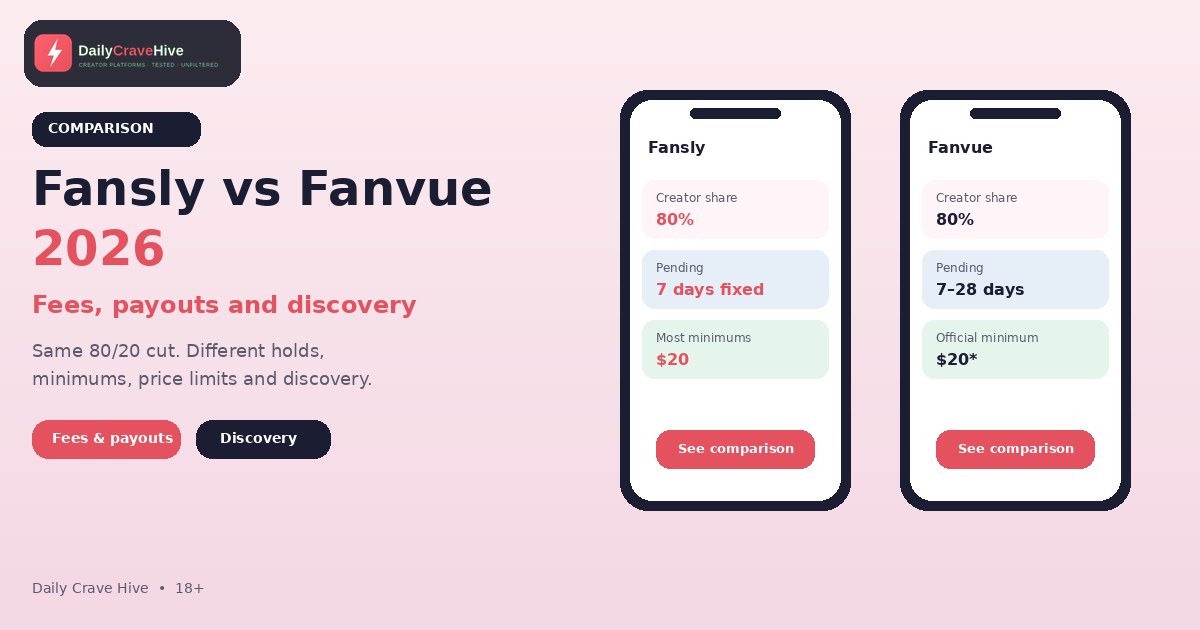
Fansly: the minimum depends on your payout method. According to Fansly's Help Center, it's $20 for Paxum, Cosmopayment and local bank deposits (including USD ACH and CAD bank deposits), $50 for SEPA transfers in the EU and UK, and $100 for international SWIFT wires and cryptocurrency. Most requests are approved within 48 hours, then typically arrive in 1–3 business days; Paxum, Cosmopayment and crypto are usually faster.
Why this matters more than it sounds: imagine you're a brand-new creator earning $60 in your first month. On OnlyFans, you withdraw it. On Fansly, you can too if you use Paxum, Cosmopayment or a local bank deposit. But if your only option is an international wire or crypto, that money sits in your balance until you cross $100 — which for a slow-starting account can take weeks longer. If you're building this income to cover real expenses, that difference is not academic.
The practical takeaway: established creators barely notice payout minimums; new creators should pick a Fansly payout method with a $20 minimum if one is available in their country, because the $100 wire/crypto threshold is felt immediately.
For a full breakdown of protecting your payments as a new seller — on any platform — our guide on how to sell content safely and get paid covers payment protection rules that apply everywhere.
Subscription Tiers: Fansly's Genuine Advantage
Here's a difference that favors Fansly clearly, especially for creators with superfans.
OnlyFans gives you one subscription price, capped at $49.99/month. Everyone who subscribes pays the same rate for the same access. Your only upsell paths are tips and pay-per-view messages.
Fansly supports multiple subscription tiers, priced up to $499/month. You can build a ladder: a cheap or free tier as a preview funnel, a mid tier for regular content, and a premium tier for your most dedicated fans with extra perks. This is the Patreon model applied to adult content — and it works, because a small percentage of fans on any platform are willing to pay far more than the average subscriber if you give them a way to.
A realistic example: suppose you have 100 subscribers. On OnlyFans at $10/month flat, that's $1,000/month gross. On Fansly with tiers — say 70 fans at $8, 25 at $20, and 5 superfans at $60 — that's $1,360/month gross from the same 100 people. Neither platform changed its cut; the tier structure changed what fans could choose to pay.
The catch: tiers only help once you have fans. Which brings us to the factor that outweighs everything else.
Audience & Discovery: OnlyFans Has the Crowd, Fansly Has the Map
OnlyFans is dramatically bigger. It's the default name in subscription content — the brand has effectively become the category. More registered users means a much larger pool of people already on the platform with payment methods attached, actively spending. OnlyFans has reportedly paid out over $25 billion to creators since 2016; Fansly doesn't publish comparable figures, but no one in the industry disputes that its audience is a fraction of OnlyFans'.
But OnlyFans has zero built-in discovery. No search that surfaces your profile, no recommendations, no explore feed. If you don't bring your own traffic — from Reddit, X, TikTok, Instagram — nobody finds you. OnlyFans is a paywall, not a marketplace.
Fansly flips this. It has a For You page, keyword search, and tagging, meaning fans inside the app can stumble onto your profile without you doing anything. For a creator starting from absolute zero — no social following, no promotion experience — this is the single strongest argument for Fansly. Organic discovery on Fansly is modest, not magic, but modest beats nothing.
The honest framing: OnlyFans is a busy city where nobody hands out maps; Fansly is a small town with signposts. If you already know how to pull a crowd, the city pays more. If you're unknown, the signposts matter.
Promotion skills decide most of this. The same social-promotion techniques we cover in our content selling guide — Reddit, anonymous accounts, consistent posting — are what actually fill an OnlyFans page.
Fansly vs OnlyFans Censorship: Content Rules Compared
Search interest in "fansly vs onlyfans censorship" exists for a reason: the platforms genuinely differ here, and picking wrong can mean removed content or a banned account.
OnlyFans runs stricter content rules. After its 2021 near-ban of adult content (announced under pressure from banking partners, then reversed within days), OnlyFans tightened its acceptable-use policy. Several legal-but-edgy content categories are restricted, enforcement can feel unpredictable, and creators in gray-area niches report more content flags and removals.
Fansly is more permissive within legal limits. Its terms allow several categories that OnlyFans restricts, which is exactly why many creators migrated during the 2021 scare and why restricted-niche creators default to Fansly today.
What both platforms absolutely require: you must be 18+, you must pass identity verification, everyone appearing in content must be verified and consenting, and illegal content is banned everywhere. No legitimate platform differs on these — and you should run from any platform that does.
The stability angle matters too. OnlyFans' 2021 reversal taught creators a lasting lesson: a platform can change its rules overnight, and your income lives on rented land. This is the strongest argument for the "run both platforms" strategy we'll cover below — not daily convenience, but insurance.
So Which Platform Actually Pays More? (Realistic Scenarios)
Time to answer the question in the title honestly — with scenarios instead of a single misleading number, because the answer depends on who you are.
Scenario 1: You have an existing audience (even a small one). You have 5,000 followers somewhere — Reddit karma, a spicy X account, TikTok. OnlyFans pays more. Your traffic converts on the platform with the most users, the strongest brand recognition (easier to market — everyone knows what an OnlyFans link is), and the most reliable payment processing. The lack of discovery doesn't hurt you because you are the discovery.
Scenario 2: You're starting from zero — no following, no promotion experience. Fansly likely pays more in your first months. Its For You page and search give you a trickle of organic eyeballs that OnlyFans simply never will. A trickle isn't a flood — you still need to learn promotion — but earning something while you learn beats earning nothing. Early earnings are small, so choose a $20-minimum payout method (Paxum, Cosmopayment or local bank) where available rather than wire or crypto at $100.
Scenario 3: Your content is restricted on OnlyFans. Fansly, by default. If OnlyFans' acceptable-use policy restricts your niche, the comparison is over — the platform where your content can't exist pays you zero.
Scenario 4: You have genuine superfans. Fansly's tier system wins meaningful money. If even 5% of your audience would pay 3–6× your base price for a premium tier, OnlyFans' single $49.99-capped subscription leaves that money on the table.
Scenario 5: You're established and serious. Run both. This is what most successful creators actually do in 2026: OnlyFans as the primary (bigger audience, easier marketing), Fansly as the secondary (backup against policy changes, tier upsells, discovery bonus). Cross-post the same content with slight timing offsets. The extra workload is real but manageable, and the income diversification has saved creators every time a platform wobbled.
How to Start on Either Platform: Step-by-Step
The setup process is nearly identical on both. Here's the path from zero to first sale:
- Verify your age and identity. Both platforms require government ID and a verification selfie. This is non-negotiable, legally required, and protects everyone. Your ID stays private — fans never see it.
- Set up an anonymous creator identity (if you want one). Separate email, stage name, no identifying details in photos or bio. Full anonymity is normal and smart in this industry — no face required.
- Price deliberately. On OnlyFans: start in the $5–10/month range to build subscribers, then raise. On Fansly: build 2–3 tiers from day one — cheap entry tier, standard tier, premium tier.
- Load 10–20 pieces of content before launch. An empty page converts nobody. Variety matters more than volume — see our guide on building a content portfolio that sells.
- Promote off-platform from day one (mandatory on OnlyFans, still valuable on Fansly): Reddit communities in your niche, an X account, cross-promotion with similar-size creators.
- Reinvest early earnings in consistency, not gear. Post on a schedule, answer messages, run occasional promos. Retention beats acquisition — keeping a subscriber is far cheaper than finding one.
- Track your numbers monthly. Subscriber count, churn, average revenue per fan, tip ratio. The creators who treat this like a business are the ones still earning in year two.
Safety, Legality & Taxes: The Non-Negotiables
Whichever platform you choose, these rules don't change:
- 18+ only, verified, always. Both platforms enforce this strictly, and so does the law.
- Never take payment off-platform. Fans who push for PayPal, Venmo, or crypto "to avoid fees" are where chargebacks and scams live. On-platform payment is your protection.
- Guard your identity. Anonymous stage name, separate accounts, no identifying backgrounds, strip photo metadata.
- Your earnings are taxable income. Both platforms report earnings in many jurisdictions, and tax authorities increasingly receive platform data. Keep simple records from your first dollar — income, dates, platform fees. Future you will be grateful.
- Read the acceptable-use policy before uploading, not after a ban. Ten minutes of reading prevents the most common account disasters.
The Verdict: Fansly vs OnlyFans in 2026
There is no universal winner — but there is a right answer for your situation.
Choose OnlyFans if: you have any existing audience or you're willing to learn promotion, you want the most reliable payment infrastructure, and your content sits comfortably within its rules. For most creators who put in promotion work, OnlyFans' audience size makes it the higher-earning primary platform.
Choose Fansly if: you're starting with zero following and want built-in discovery, your niche is restricted on OnlyFans, or you have superfans who'd pay premium tier prices that OnlyFans' single $49.99 subscription can't capture. Check which payout methods work in your country, since minimums range from $20 to $100.
Choose both if: you're serious about this as an income. Primary on OnlyFans, secondary on Fansly, cross-post everything, and sleep better knowing one platform's policy change can't zero your income. This is the standard playbook for established creators in 2026, and for good reason.
And whichever you pick — the platform is only the storefront. Content quality, pricing strategy, promotion, and consistency decide your income far more than the logo at the top of your page. The 20% cut is identical everywhere; what you do with the 80% is not.
Frequently Asked Questions
Fansly vs OnlyFans — which is better for creators?
It depends on your starting point. OnlyFans is better for creators who have (or can build) their own audience: it has far more users and stronger payment infrastructure. Fansly is better for creators starting from zero, because its For You page and search provide organic discovery OnlyFans completely lacks, and for creators whose content is restricted under OnlyFans' rules. Both take the same 20% commission, so the "better" platform is the one whose strengths match your situation — and many established creators run both.
Do Fansly and OnlyFans take the same cut?
Yes. Both platforms take a flat 20% commission on all earnings — subscriptions, tips, pay-per-view, and custom content — so creators keep 80% on either platform. Neither offers volume discounts. The fee is identical; the real differences are payout minimums, subscription tiers, audience size, discovery, and content rules.
What is Fansly used for?
Fansly is a subscription content platform where creators sell access to their content through monthly subscriptions, tips, pay-per-view messages, and custom requests. It's most commonly used for adult content, but also hosts cosplay, fitness, modeling, and lifestyle creators. It works like OnlyFans with the same 20% fee, but adds built-in discovery (a For You page and search) and multi-tier subscriptions up to $499/month.
What are the main differences between Fansly and OnlyFans?
Five differences matter: (1) audience — OnlyFans is several times larger; (2) discovery — Fansly has a For You page and search, OnlyFans has none; (3) subscriptions — Fansly offers multiple tiers up to $499/month, OnlyFans has one tier capped at $49.99; (4) payouts — OnlyFans has a minimum (commonly reported at $20) with 3–5 day processing, Fansly's minimum is $20 for most methods ($50 SEPA, $100 wire/crypto), with most requests approved within 48 hours; (5) content rules — Fansly is more permissive, OnlyFans stricter. Commission is identical at 20%.
Is Fansly safer than OnlyFans?
Both are legitimate, established platforms with identity verification, on-platform payment protection, and legal compliance requirements. Neither is meaningfully "safer" than the other for creators who follow standard safety rules: verify only through official channels, never take payment off-platform, and protect your identity. The bigger safety factor is your own practices, not the platform choice.
Can I use both Fansly and OnlyFans at the same time?
Yes — neither platform prohibits having accounts on the other, and running both is the standard strategy for established creators in 2026. Most use OnlyFans as their primary (larger audience) and Fansly as secondary (backup against policy changes, tier upsells, extra discovery), cross-posting the same content to both. The main cost is extra time managing two message inboxes and schedules.
Do you have to show your face on Fansly or OnlyFans?
No. Both platforms require identity verification privately (government ID that fans never see), but neither requires your face in your content. Many successful creators on both platforms work completely anonymously — stage name, no face, no identifying details. Anonymity is normal in this industry and strongly recommended for privacy.
How do payouts work on Fansly vs OnlyFans?
On both platforms, fans pay, the platform takes its 20%, and the remaining 80% becomes your available balance after a short hold. OnlyFans lets you withdraw once you reach its minimum (commonly reported at $20), with processing in 3–5 business days. On Fansly, the minimum is $20 for Paxum, Cosmopayment and local bank deposits, $50 for SEPA, and $100 for international wires and crypto; most requests are approved within 48 hours and then typically arrive in 1–3 business days. Always confirm current payout terms on the platform's official documentation, as these change.
Alma MartinEditor, Daily Crave Hive
Alma Martin is the editor at Daily Crave Hive. She reviews creator and adult platforms - fees, payouts, safety and more - so readers get honest guides before they sign up.