18+ Disclosure: This guide is for adults aged 18 or over who want to sell content legally and safely. Some links may be affiliate links — we may earn a commission at no extra cost to you (see our affiliate disclosure). Earnings vary widely; nothing here is a guarantee of income.
The most common feet pic scams, from fake payment screenshots to overpayment and allowance tricks, plus red flags and how to get paid safely.
Feet pics attract genuine buyers, and they also attract scammers. Most new sellers meet a scammer before they meet a serious buyer. The messages look different each time, but they rely on the same few tricks: get you to deliver first, get you to send money back, or get enough personal information to pressure you later.
This guide explains the scams sellers run into most, how each one works, and how to protect yourself. Where we describe what consumer agencies say, we quote the Federal Trade Commission (FTC) and the FBI. Descriptions of specific feet pic scam scripts come from patterns commonly reported by sellers. We haven't tested them ourselves. Payment and reporting rules can change, so check the official site of your platform or payment app for the current process.
If you're just getting started, our guide on how to sell feet pics and make money covers the basics. This article focuses only on scams and getting paid safely. For agency, phishing and account-theft scams on subscription platforms, see our guide to OnlyFans scams targeting creators.
Feet Pic Scams At A Glance
| Scam | What the "buyer" wants | Main red flag | Safe response |
|---|---|---|---|
| Fake payment screenshot | Your content before real payment | Payment "proof" sent as an image or email | Check your own account, not their screenshot |
| Overpayment and refund | You to send back the "extra" | Paid too much, asks for a refund | Never refund an overpayment yourself |
| Weekly allowance or "sugar" offer | A fee to "unlock" your money | You must pay before you get paid | Walk away |
| Gift card payment | Gift card numbers or PINs | Insists on gift cards | Refuse; only scammers ask for this |
| Free "verification" photo | Free custom content | Wants a new photo before paying | Offer only watermarked previews |
| Off-platform move | No transaction record | Pushes to move chat elsewhere immediately | Keep payment and delivery on the platform |
| Sextortion or doxxing threats | Money to stay quiet | Threatens to expose you | Stop, save evidence, report |
Why Feet Pic Sellers Are A Target
Scammers go after new sellers because they're often keen to make a first sale, unsure what normal buyer behaviour looks like, and selling digital content that can't be "returned." Once you deliver an image, it's delivered for good.
Sellers who arrange payment privately (outside a marketplace) carry most of the risk. A dedicated platform with on-site payments gives you a transaction record and a set of rules. Our list of the best websites to sell feet pics covers the main marketplaces. Our FeetFinder review explains how one of them handles payments and verification.
The Most Common Feet Pic Scams
1. The Fake Payment Screenshot
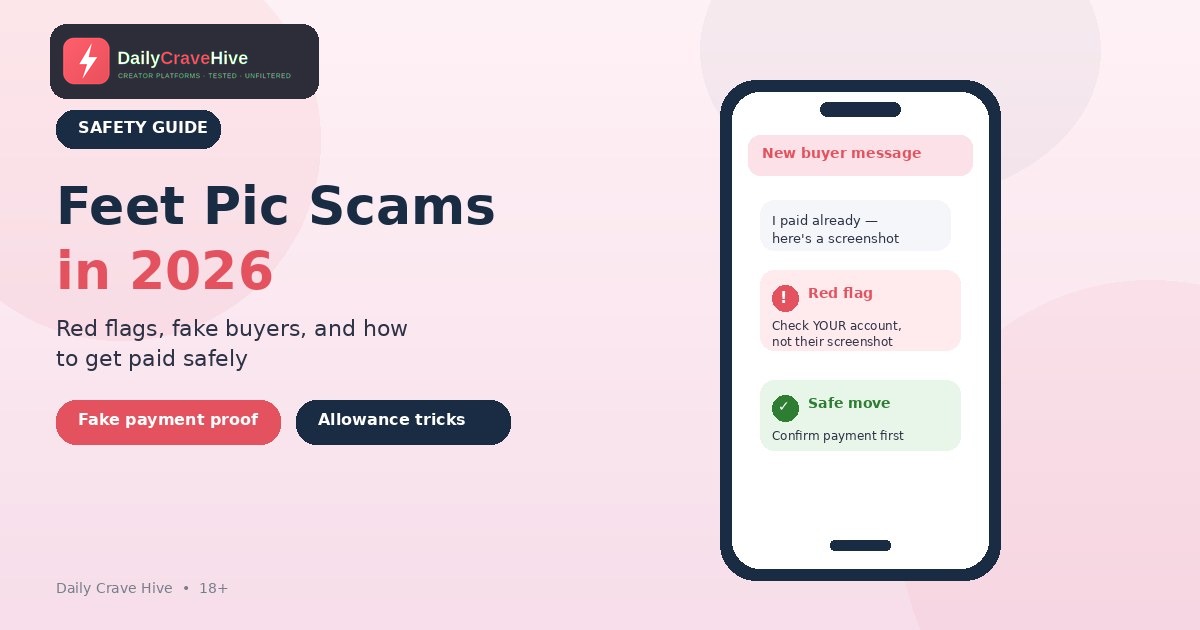
How it works: The buyer says they've paid and sends a screenshot, a forwarded "receipt" or an email that looks like it came from a payment app. They ask you to send the content now.
Why it works: Screenshots and emails are easy to fake. A real payment shows up in your own account, not in an image someone sends you.
What to do: Open your payment app or platform yourself, without clicking any link the buyer sent, and check the balance. The FTC's guidance on mobile payment apps says scammers target these apps because "once you do [send money], it's hard for you to get your money back." No payment in your account means no content.
2. The Overpayment And Refund
How it works: The buyer "accidentally" pays you too much, often by check or a payment that can later be reversed. They ask you to send back the difference.
What the FTC says: Its fake check scam guide describes buyers who "'accidentally' send a check for too much, and ask you to refund the balance. But that's a scam." The FTC's guide on refund and recovery scams adds: "It can take weeks for a bank to discover that a check it cleared was a fake. In the meantime, if you return money to the scammer, the bank will want you to repay that money."
What to do: Don't refund an overpayment yourself. If it happened on a platform, contact the platform. If it happened privately, don't touch the funds until your bank confirms the payment is final.
3. The Weekly Allowance Or "Sugar" Offer
How it works: A "generous" buyer offers a regular allowance, often hundreds of dollars a week, just for pictures or attention. There's a catch. Before the first payment can arrive, you need to pay something: an "activation fee," a "transfer fee," a "verification" payment, or a small amount to "prove you're not a scammer."
Why it works: The promised income is big enough that a small fee seems worth it.
What to do: Any request to pay money to receive money is a scam. The FTC's refund and recovery scams guidance makes the same point: anyone who asks for upfront fees to send you money "is a scammer." Real buyers pay you. You never pay them.
4. Gift Card Payments
How it works: The buyer offers to pay in gift cards, or asks you to buy a gift card to "unlock" a payment or cover a fee.
What the FTC says: "Gift cards are for gifts, not payments. Anyone who demands payment by gift card is always a scammer," according to the FTC's fake check scam guide. Its gift card scam guide says: "Only scammers will tell you to buy a gift card... and give them the numbers off the back of the card."
What to do: Don't accept gift cards as payment and never buy one for a buyer.
5. The Free "Verification" Photo
How it works: Before they'll pay, the buyer wants a free custom photo, such as your foot with their name written next to it, "to prove you're real."
Why it works: It sounds reasonable. But that custom photo is the product, and once you've sent it, they have no reason to pay.
What to do: Point them to your watermarked profile previews. If a buyer needs proof you're real, a verified marketplace profile is enough.
6. "Kindly" Messages And Scripted Openers
How it works: Sellers commonly report messages with the same scripted tone: overly formal or overly familiar wording, phrases like "kindly send," fast compliments and pressure to act now. These aren't proof of a scam on their own. Plenty of genuine buyers write in a second language. But together with pressure and an unusual payment request, they're a warning sign.
What to do: Judge buyers by what they ask you to do, not how they write. Follow the payment rules every time.
7. Pressure To Move Off-Platform
How it works: The buyer wants to move straight to another messaging or payment app. Once you're off the marketplace, there's no record and no protection.
What to do: Keep agreeing the order, payment and delivery on the platform, especially with new buyers. If a platform's rules forbid off-site payment, moving off-site can also risk your account.
8. Sextortion And Doxxing Threats
How it works: Someone gets your images or personal details and threatens to share them with your family, employer or followers unless you pay.
What the FBI says: The FBI's guidance on financially motivated sextortion is mainly aimed at minors and young adults, but its advice applies widely: get help "before sending money or more images," because "cooperating with the predator rarely stops the blackmail." It also advises reporting the account through the platform's safety feature, blocking the person and saving every interaction.
What to do: Don't pay. Save the messages, report the account, block it and contact law enforcement. In the US, the FBI takes reports at tips.fbi.gov.
Red Flags Checklist Before You Accept A Custom Order
Before you take a custom order, run through this list. If you tick even one, slow down:
- The buyer wants content before a confirmed payment shows in your account
- They send payment "proof" as a screenshot or link
- They paid too much and want money back
- They offer an allowance and need a fee first
- They mention gift cards, wire transfers or crypto
- They want a free custom "verification" photo
- They push to move off the platform immediately
- They ask for your real name, location, workplace or other social accounts
- They create urgency: "right now," "last chance," "my account closes today"
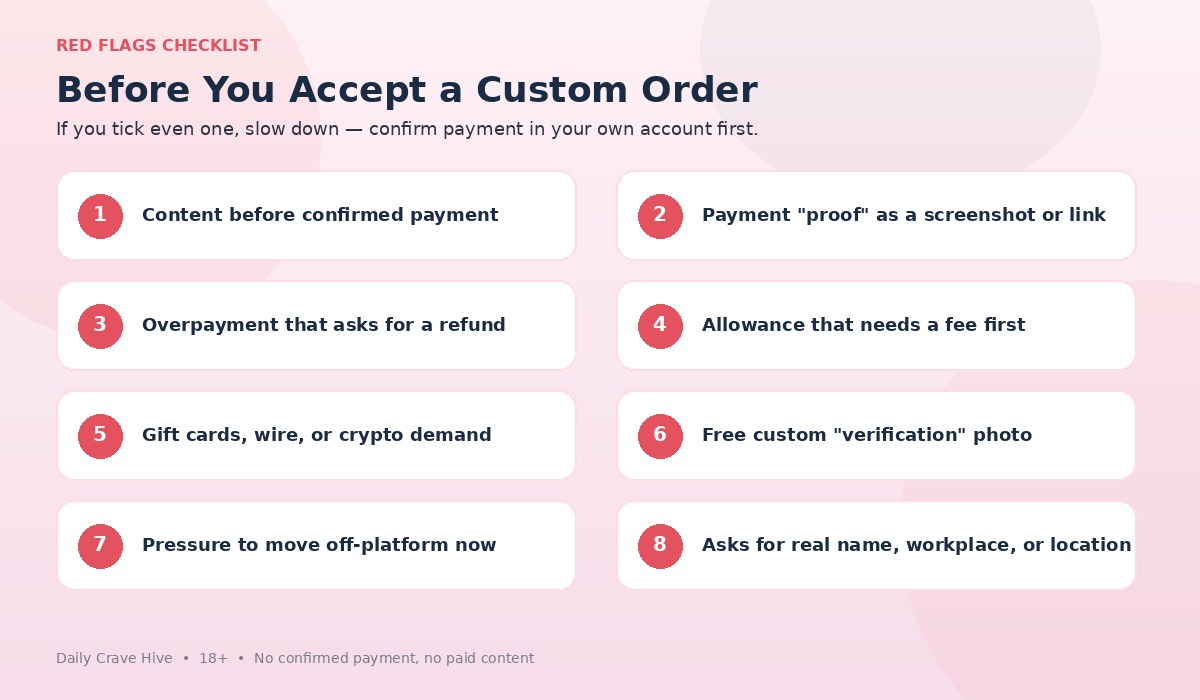
If even one of these shows up, slow down and confirm payment in your own account.
How To Get Paid Safely For Feet Pics
Use A Platform With On-Site Payments
The simplest protection is selling through a marketplace that handles payments, so the buyer pays the platform before you deliver. Each platform has its own rules on fees, holds and chargebacks, so check the official site before you sign up. Our feet pics pricing guide helps you set prices once you've chosen where to sell.
For a specialist marketplace with ID-checked members and on-platform payments, many sellers start on FeetFinder. Read our FeetFinder review for fees, verification and payouts before you join.
Confirm Payment In Your Own Account
Never trust payment proof sent by the buyer. Open the app or website yourself and check that the money is actually there.
Deliver Only After Payment Clears
For custom orders, the payment should show as complete before you start, or at least before you deliver.
Keep Your Identity Separate
- Use a stage name and a separate email address for selling
- Keep your face, tattoos, jewellery and recognisable backgrounds out of shots
- Don't link your selling profile to your personal social accounts
- Remove location data from photos before uploading, if your phone or platform doesn't do it automatically
Keep Records
Screenshot your conversations and orders. If something goes wrong, records help your platform, your payment provider and law enforcement.
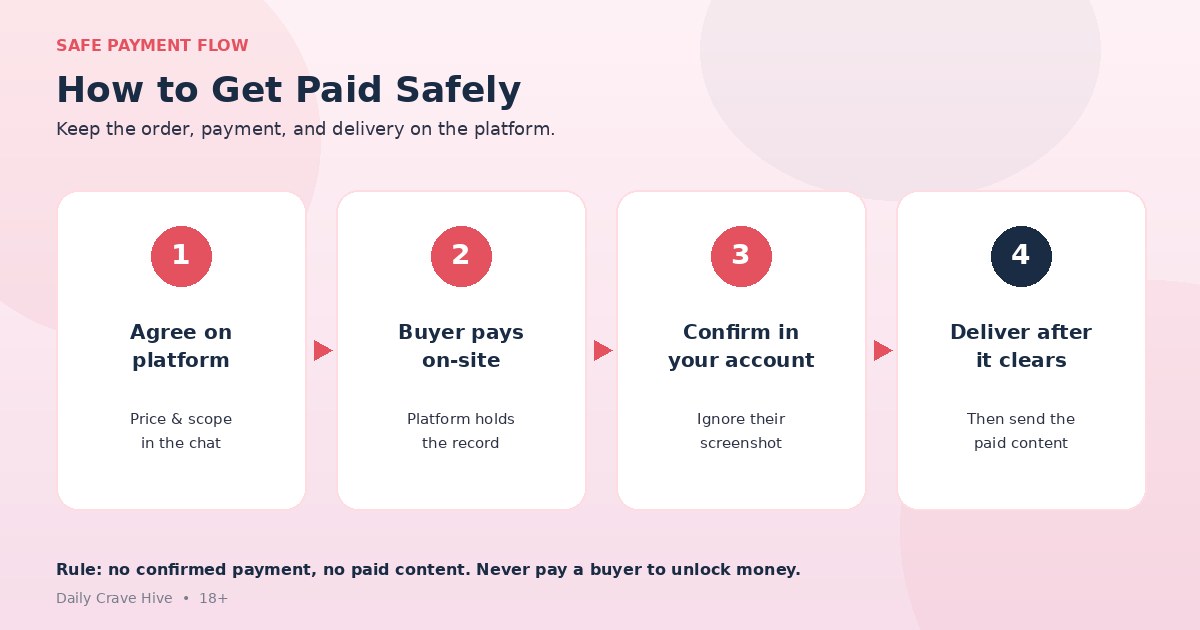
Watermarked previews and on-platform payments protect sellers from most common scams.
What To Do If You've Been Scammed
Acting quickly gives you the best chance of recovering money. The FTC's guide What To Do if You Were Scammed suggests these steps:
- Payment app: report it to the app immediately and ask them to reverse the payment.
- Gift card: contact the gift card company right away and ask for your money back. Keep the card and receipt.
- Wire transfer: contact the wire company or bank, report a fraudulent transfer and ask for a reversal.
- Report the scam: in the US, report it to the FTC at ReportFraud.ftc.gov.
- Report the account to the platform where you met the buyer.
- Threats or blackmail: save everything and contact law enforcement.
Outside the US, contact your local police and your country's consumer protection or cybercrime agency. Rules vary by country.
Frequently Asked Questions
How do I know if a feet pic buyer is real?
A real buyer pays first through the platform or a payment you can confirm in your own account. Warning signs include fake screenshots, overpayments, fees before payment, gift cards and demands for free custom photos.
Is the weekly allowance offer real?
If it asks you to pay anything to receive the allowance, it's a scam. Real buyers pay you; you never pay them to unlock money.
Can a buyer reverse a payment after I send the pictures?
It can happen. The FTC notes that fake checks can take weeks to discover, and payment platforms have their own chargeback rules. Selling through a marketplace and waiting for payment to clear reduces this risk. Check your platform's official policy.
Should I send a free sample to prove I'm real?
No. Use watermarked previews on your profile. A free custom photo is the product itself.
What should I do if someone threatens to leak my pictures?
Don't pay and don't send more content. Save the messages, report and block the account, and contact law enforcement. In the US, the FBI takes reports at tips.fbi.gov.
Where do I report a feet pic scam?
Report it to the platform and the payment provider first. In the US, also report it to the FTC at ReportFraud.ftc.gov. Elsewhere, contact your local police or consumer protection agency.
Final Thoughts
Feet pic scams come in many versions, but they follow a few simple patterns: deliver first, send money back, pay to get paid, or pay to stay quiet. If you keep payments on a platform, confirm money in your own account, never pay a buyer, and keep your identity separate, you avoid most of them. When something feels off, it usually is. Take your time, and don't let anyone rush you.
Last checked: October 13, 2026. This guide is for adults aged 18 and over.
Alma MartinEditor, Daily Crave Hive
Alma Martin is the editor at Daily Crave Hive. She reviews creator and adult platforms - fees, payouts, safety and more - so readers get honest guides before they sign up.