Editorial note: This guide is for adults (18+) and focuses on lawful, consensual, online-only content. Platform rules, fees, payout methods, and local laws can change. We checked the cited public pages and terms. Earnings are never guaranteed. This article is educational information, not legal, tax, or financial advice.
If you want to sell feet pics and make money, focus on choosing a platform with real transaction tools, clear prices, privacy, and a way to convert profile views into a first paid order.
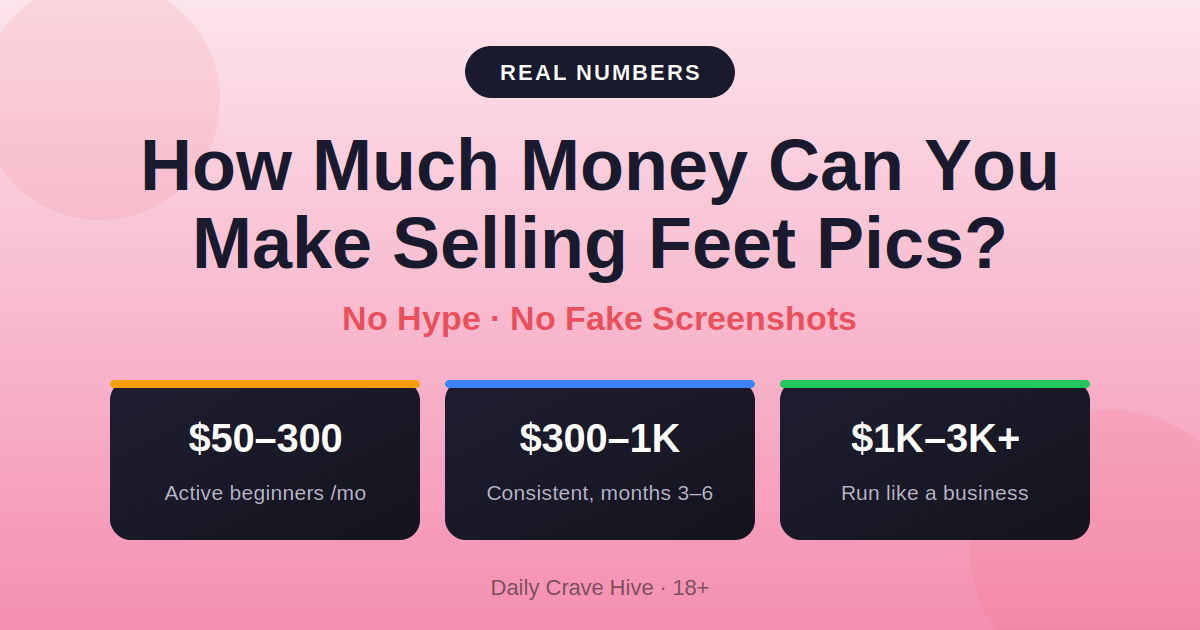
That is also where many beginner guides go wrong. They make it sound like you upload a few pictures and wake up to hundreds of dollars. Realistically, some creators make sales and some make nothing. There is no trustworthy industry-wide "average income" for feet-pic sellers, and testimonials on marketplace homepages are marketing claims, not a forecast of what you will earn.
The better approach is to treat this like a tiny digital-content business: one niche, one primary marketplace, a small product menu, clear boundaries, safe payments, and weekly testing.
Quick Answer: How Do You Sell Feet Pics and Make Money in 2026?
To sell feet pics and make money, start by choosing a reputable platform that accepts your type of content and operates in your country. Create a separate creator identity, complete any required age/ID verification, publish 3–5 clear listings, and offer a low-friction starter bundle plus higher-priced custom work. Keep payment and order details inside the platform whenever possible, use watermarked previews, and never pay a buyer or send paid content before payment is confirmed.
For pricing, a useful 2026 reference point comes from FeetFinder's own July 2026 guide: it says observed listings commonly fell around $5–$20 for individual photos, $15–$40 for bundles, and $20–$75 for short videos. Treat those as marketplace reference ranges, not guaranteed market averages. Your niche, quality, reputation, platform fees, and buyer demand can move your actual selling price up or down.
If you only remember one idea from this guide, remember this: your first goal is not maximum price; it is a safe, repeatable first transaction. 🏆 Editor's Pick — Safest Start for Beginners
Most first-time sellers start on FeetFinder — millions of verified buyers, on-platform payment protection, and reliable weekly payouts. It removes the two biggest beginner risks: no buyers, and no protection.
Is Selling Feet Pics Actually a Real Way to Make Money?
Yes, selling feet pictures online is a real form of digital-content selling. Specialist marketplaces including FeetFinder, FootLove, and Feetify currently provide ways for creators to list or monetize feet-focused photos and videos. But "real" does not mean "easy," "passive," or "guaranteed."
Creators generally make money through a mix of:
- individual locked photos;
- themed photo bundles;
- short videos where allowed;
- custom photo or video requests;
- tips or paid messages where the platform offers them;
- subscriptions or repeat-buyer offers on platforms that support them. Think in buyer relationships, not one-photo jackpots. A starter bundle that leads to a custom order and a later repeat purchase can be more valuable than chasing one unusually expensive first sale.
Is It Legal and Safe to Sell Feet Pics?
For an adult selling lawful, consensual photos of their own feet, the activity can be legal, but laws differ by country and sometimes by state or region. The safest answer is not "it is legal everywhere." It is: confirm your local rules and follow the exact content policy of the platform you use.
Every person shown must be an adult who consented to creation and distribution. Never involve minors, upload someone else's content without permission, or agree to an illegal request.
Platform rules can also be stricter than the law. For example, FootLove's current Content Provider Agreement says creators must be 18+, maintain consent and age documentation for anyone depicted, and must not upload nudity or sexually explicit/NSFW material. Its Terms of Service say users must be at least 18 and go through age verification. FeetFinder also requires seller identity verification and publishes seller rules in its Seller Agreement.
If you plan sexually explicit material rather than ordinary feet photography, different rules may apply. In the U.S., separate federal recordkeeping requirements can apply to producers of certain sexually explicit depictions. Get qualified legal advice if your content may fall into that category.
Where to Sell Feet Pics in 2026: The Platforms That Matter
If you are asking where to sell feet pics, start with specialist marketplaces before trying to close deals through random social-media DMs. A marketplace cannot remove every risk, but on-platform profiles, verification, payment records, and dispute processes give you more structure than an informal chat with a stranger.
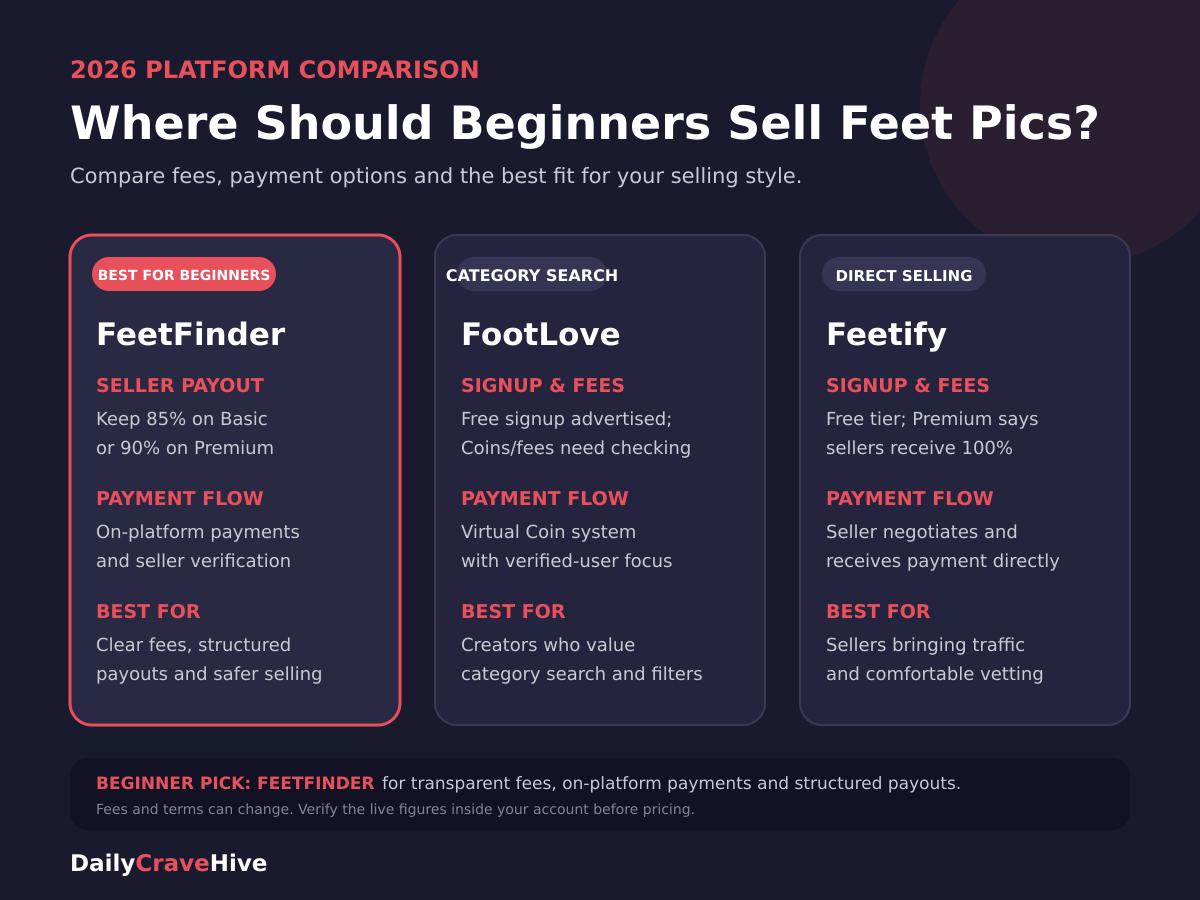
Here is the current beginner-level comparison.
| Platform | Current seller cost / fee information | Useful for | Important catch |
|---|---|---|---|
| FeetFinder | Per its Seller Agreement, two costs apply. Platform fee (subscription): Basic $4.99/mo, $14.99/yr or $40 lifetime; Premium $14.99/mo, $49.99/yr or $80 lifetime. Service fee: 15% on Basic (keep 85%) or 10% on Premium (keep 90%). | Beginners who want a feet-specific marketplace with on-platform payments and weekly bank payouts | It is not free to sell; seller competition is real |
| FootLove | Free signup is advertised. Public terms say transactions use Coins and earnings can be subject to platform/processing fees; an exact creator percentage is not clearly stated on the public agreement we reviewed. | Creators who want a feet-specific marketplace with verified-user positioning and category search | Verify the live Coin conversion, seller fees and withdrawal terms inside your account before pricing |
| Feetify | Free to join and post some media. Feetify says Premium sellers can receive 100% of buyer payments; its current Premium upgrade path is tied to qualifying FeetFinder plan purchases. | Sellers comfortable negotiating direct payments and bringing some of their own traffic | Direct buyer-to-seller payments shift more scam/payment risk to you; confirm the current Premium process before paying |
Sources: FeetFinder payouts/seller pages, FootLove Terms & Content Provider Agreement, Feetify FAQ & Premium upgrade page. Always verify the live figures inside your own account before pricing.
1. FeetFinder: the clearest fee structure for beginners to compare
FeetFinder is useful in this guide because its public 2026 terms are unusually specific. Its payouts page advertises that sellers can earn up to 90% on sales, with weekly payouts sent directly to your bank account and PCI-DSS compliant payment processing. But the Seller Agreement fills in the important detail, and it is worth understanding before you join.
There are two separate costs:
- A service fee on sales. Per FeetFinder's current Seller Agreement, this is 15% on the Basic plan (so you keep 85% of buyer payments) or 10% on the Premium plan (so you keep 90%). That is why the "90%" headline is really the Premium-tier figure — a Basic seller keeps 85%.
- A seller subscription (platform fee). A recurring plan fee is required to sell. Per the Seller Agreement, the Basic plan is $4.99/month, $14.99/year, or $40 for lifetime access; the Premium plan is $14.99/month, $49.99/year, or $80 for lifetime. You need a valid card on file, and the fee is charged in advance of each term.
That makes the math easy to understand before you join. It also requires seller ID verification and handles buyer payments through approved payment providers rather than asking sellers to invent their own checkout process. The downside is obvious: you pay a platform subscription before a sale is guaranteed, and a marketplace with many sellers still requires a good profile, listings, and promotion.
✅ Ready to try FeetFinder? Verified buyers, secure on-platform payments, and weekly bank payouts make it the easiest place to land your first safe sale.
2. FootLove: strong search/category structure, but verify live economics
FootLove's public site uses a four-step journey — create a profile, upload media, attract buyers, get paid — and exposes categories such as pedicure, sneakers, socks, nail polish, high heels, and lotion. Its current terms state an 18+ requirement, third-party age verification, a ban on minors/NSFW content, and a virtual Coin transaction system. The content agreement says earnings are subject to platform/processing fees, so confirm the live Coin conversion and withdrawal terms before pricing. "Free to join" does not tell you what you net.
3. Feetify: attractive 100% language, with more responsibility on the seller
Feetify emphasizes "free to join" and says Premium sellers can receive 100% of buyer payments. But its own FAQ says sellers can negotiate prices and receive payments directly. For a beginner, that trade-off matters: a larger percentage is only useful if you can find legitimate buyers and get paid safely. Our Feetify Review 2026 goes deeper into the model.
Can You Sell Feet Pics Free?
People searching sell feet pics free usually mean one of two things: "Can I create an account for free?" or "Can I complete the entire sale without any platform cost?" Those are different questions.
Feetify says it is free to join and lets free members post some media, but Premium unlocks important selling/communication benefits. FootLove advertises free signup, yet its terms reference subscriptions, Coins, platform fees, and processing charges.
Free social promotion is possible, but direct-message selling moves verification, payment, dispute, and privacy work onto you. Compare net profit and risk, not just "free."
How Much Should You Charge for Feet Pics?
Pricing is where beginners usually swing too far in one direction. Some underprice everything because they want a first sale. Others see a viral income claim and list an ordinary photo at $100 with no reviews or buyer history.
A better starting point is a small price ladder.
FeetFinder's July 2026 guide says its observed active-seller listings were commonly around:
- $5–$20 for an individual photo;
- $15–$40 for a bundle;
- $20–$75 for a short video;
- custom content at a premium based on the request. These numbers come from one marketplace's published observation, not an independent industry census. Use them as a testing range, not as proof that your content will sell at those prices.
A beginner pricing menu that is easy to understand
You can turn those ranges into a cleaner storefront:
| Offer | Example test price | Purpose |
|---|---|---|
| 1 paid photo | $7–$12 | Low-risk trial for a new buyer |
| 5-photo starter set | $15–$25 | Your easiest first-sale offer |
| 10-photo themed set | $25–$40 | Better average order value |
| Short video, if permitted | $25–$60 | Higher-effort product |
| Custom 5-photo set | $30–$60+ | Premium for your time and specificity |
Those are example starting tests within or near current marketplace reference ranges — not guaranteed rates.
Use a formula for custom orders
For custom work, stop guessing. Use:
Custom price = production time + editing/admin time + prop costs + platform fees + complexity premium
Suppose a request will take 30 minutes to plan and shoot, 15 minutes to edit/deliver, and another 15 minutes of messages. That is an hour of work. If you want the order to generate at least $30 before taxes and your platform takes 15%, pricing it at $30 gross leaves only $25.50 before other costs. You would need to price higher to hit your target.
This is why "how much do feet pics sell for?" has no single correct answer. The correct price is one that a buyer accepts and that leaves you enough money for the work and risk involved.
When should you raise your price?
Raise it when the evidence supports it — not because a creator on social media posted a screenshot.
Good signals include:
- the same bundle sells repeatedly at the current price;
- buyers request customs faster than you can comfortably fulfill them;
- repeat buyers purchase without needing discounts;
- you have improved quality, variety, or turnaround;
- your average order value is rising while conversion stays healthy. Change one variable at a time. If you increase every price, redesign your profile, and change your niche on the same day, you will not know what caused the result.
The Exact First-Sales Strategy for Beginners
This is the practical core of how to sell feet pics and make money without turning it into a full-time marketing project on day one.
Step 1: Pick one primary marketplace, not five
New sellers often create accounts everywhere and end up maintaining none of them well. Choose one primary platform for your first 14 days. Add a second only after you have enough content and a routine.
For your comparison, score each platform from 1–5 on:
- seller fee and commission;
- ID/age verification;
- whether payment stays on-platform;
- payout method in your country;
- content rules that match what you want to create;
- category/search tools;
- whether you are comfortable with its privacy policy and terms. If a platform will not tell you what you pay, how you withdraw, or what content is permitted, pause before uploading.
Step 2: Build a separate creator identity
Choose a pseudonym that is not connected to your real name or personal social usernames. Create a separate email address for the business. Use a unique password and turn on two-factor authentication where available.
Remember: being anonymous to buyers is different from being anonymous to the platform. A legitimate marketplace may require your legal name, ID, bank details, or tax information privately to verify you and pay you. Do not fake that information. Your goal is public privacy, not bypassing compliance.
Step 3: Choose two content lanes
Instead of "I sell any feet pics," choose two clear lanes that can become recognizable.
Examples:
- clean pedicure + nail-color sets;
- sneakers + socks;
- spa/lotion aesthetic;
- soles + arches;
- seasonal color themes;
- outdoor/summer lifestyle shots. This mirrors what strong marketplace pages do well: they turn a vague product into searchable categories. FootLove, for example, currently exposes categories such as Barefoot, High Heels, Lotion, Nail Polish, Pedicure, Sneakers, and Socks. FeetFinder's 2026 guide similarly recommends niche/category terms.
Choose categories you are actually comfortable producing. You never need to accept a request that crosses your boundaries.
Step 4: Shoot a 20-photo starter library
You do not need a DSLR. A modern phone, clean lens, stable framing, and indirect daylight are enough to start.
Shoot 20 usable images in two or three setups. Vary angle, background, nail color, footwear, or props so they do not look like duplicates. Keep the background simple. Remove mail, family photos, street views, reflections, school/work items, or anything else that could identify you.
Then divide the library into:
- 3–5 watermarked preview images;
- one 5-photo paid starter set;
- one 10-photo themed set;
- several reserve images for future posts. Do not publish your entire library for free. A preview should prove quality, not replace the paid product.
Step 5: Build a profile that answers buyer questions in 10 seconds
A buyer landing on your profile should instantly understand four things: what style you make, what they can buy now, whether you accept custom requests, and how quickly you usually respond or deliver.
A simple beginner bio could be:
"Clean pedicure + sneaker sets. New photos weekly. 5- and 10-photo bundles available; custom color/theme requests open when listed. Orders and payment stay on-platform."
That is stronger than "DM me for feet pics" because it defines the niche, cadence, products, and transaction boundary.
Step 6: Publish three products, not a random gallery
Start with a tiny catalog:
- Starter: 5-photo set at an accessible price;
- Core: 10-photo themed bundle at better per-photo value;
- Custom: clearly scoped custom option with a starting price. Use descriptive listing titles. "10 Red Pedicure Photos — Indoor Daylight Set" tells a buyer more than "New pics." Include the number of files, general theme, and what is not included if boundaries could be misunderstood.
Do not stuff every possible keyword into the listing. Clear language converts better than a wall of repeated tags.
Step 7: Use safe previews to get attention
If your platform permits external promotion, use tasteful, watermarked previews on social networks or communities whose current rules allow that content. Do not assume rules stay the same; check before posting.
Your preview needs one job: send an interested person to your official seller profile. It does not need to give away the full paid set.
Avoid publishing your real name, exact city, workplace, school, phone number, or personal accounts alongside promotion. Do not meet buyers in person.
Step 8: Reply like a small business, not like a desperate seller
Fast, clear replies reduce buyer uncertainty. You do not need to be available 24/7.
For a custom request, try:
"Yes, I can do that style within my listed boundaries. My 5-photo custom set starts at $35. Tell me the color/theme you want and I'll confirm the exact scope, price and delivery time here before you order. Payment and delivery stay on-platform."
For discount requests:
"My best-value option is the 10-photo bundle. I keep custom pricing fixed because it includes planning and editing."
For free samples:
"I don't send free custom samples, but the watermarked previews on my profile show the quality and style you'll receive."
Professional does not mean saying yes to everything. Boundaries make transactions simpler.
Step 9: Make the first purchase easy
Your starter offer should answer "What is the cheapest safe way to see if I like this creator's work?" That is why a small bundle can be more useful than pushing a high-priced custom immediately.
You can test a genuine limited launch offer, but do not train buyers to expect permanent discounts or invent fake scarcity.
Step 10: Confirm payment before you deliver
Check payment inside the platform or your actual approved payment account. A screenshot sent by a buyer is not proof.
The U.S. Federal Trade Commission warns online sellers about fake payment notifications and bogus refund requests. It also warns that fake-check overpayments can appear in an account before the bank later discovers the check is bad.
Do not send the paid files until the transaction status says you should deliver under the platform's process.
Step 11: Turn sale #1 into information
After a successful order, record: the product sold, gross price, platform fee, net before tax, how the buyer found you (if known), what theme they chose, and whether they returned.
Then make the next listing based on evidence. If a pedicure bundle gets 15 clicks and your sneaker set gets two, that tells you what to test next.
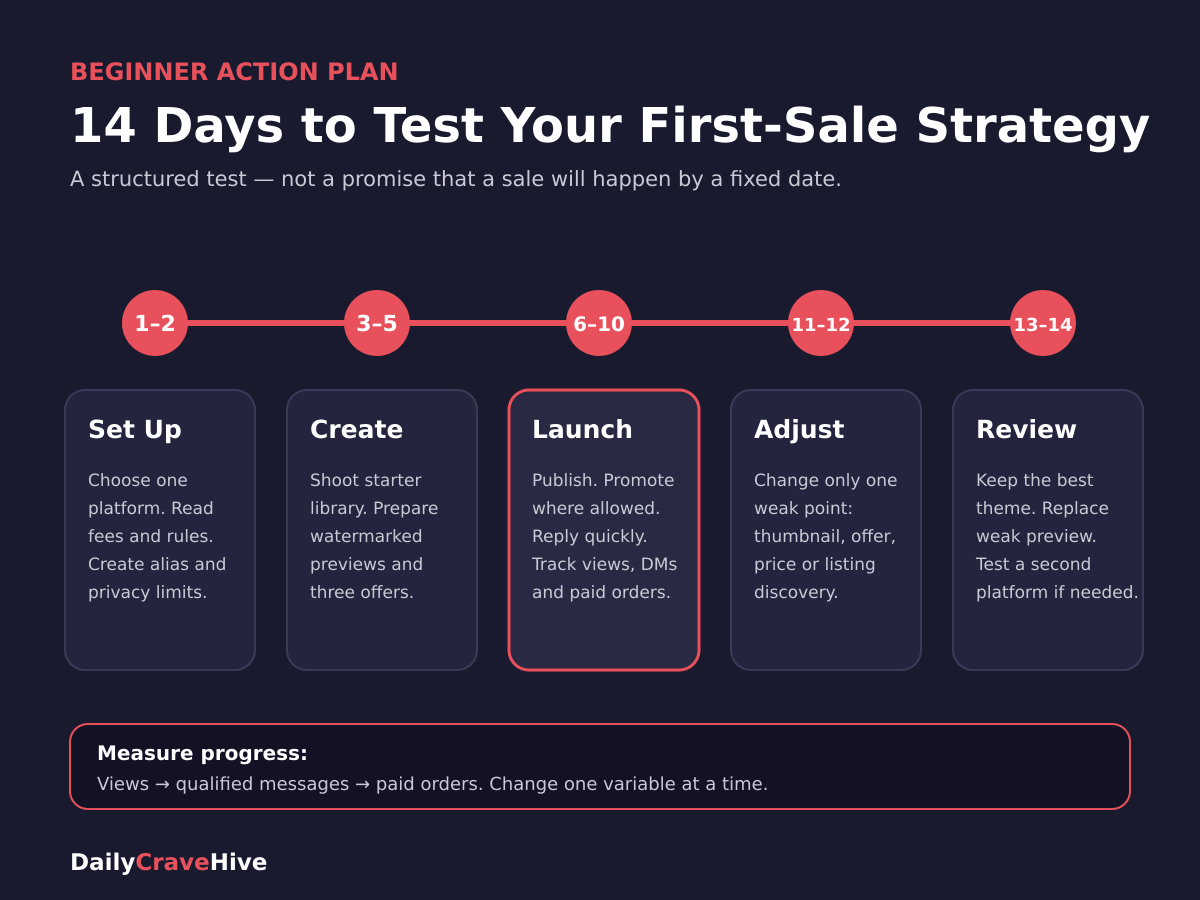
A 14-Day Plan to Get Your First Sale
There is no guaranteed timeline, but a fixed test period keeps you from changing strategy every few hours.
- Days 1–2: choose one platform, read its fees/rules, complete verification, set up your alias and privacy boundaries.
- Days 3–5: shoot your starter library, prepare watermarked previews, complete your profile and publish three clear offers.
- Days 6–10: launch, use permitted promotion, reply promptly, and record views, messages and orders.
- Days 11–12: change one weak point. Views but no messages? Improve thumbnails/positioning. Messages but no orders? Test the starter offer. No views? Improve categories, cadence and discovery.
- Days 13–14: keep the strongest theme, replace the weakest preview, and publish one evidence-based new bundle. If qualified activity is still near zero, compare a second marketplace rather than endlessly discounting.
How to Sell Feet Pics Without Getting Scammed
If you want to sell feet pics and make money consistently, scam prevention is part of the business model. A $40 sale is not a win if it causes a $200 loss or exposes your identity.
Red flag #1: "Pay a fee to receive my payment." Do not pay a buyer to unlock an allowance, business account, transfer, verification, or prize. If a legitimate platform charges you, that fee should appear in the platform's official checkout or agreement — not in a stranger's DM.
Red flag #2: fake payment screenshots. The FTC specifically warns sellers about fake mobile-payment notifications. Open the official app/site yourself and check the transaction there. Do not click the buyer's "payment confirmation" link.
Red flag #3: overpayment plus refund. "I accidentally sent $500 instead of $50; send $450 back" is a classic fraud pattern, especially when checks are involved. Funds from a fake check can appear available before the bank discovers the fraud weeks later.
Red flag #4: gift cards or strange payment detours. The FTC warns that gift cards are a common scam payment method. If a stranger tells you to buy cards, send PINs, pay a fee in crypto, or route money to a third person to complete your sale, stop.
Red flag #5: free custom "verification" photos. A public, watermarked preview is enough to show that you create real content. A buyer who insists on a new custom photo before paying is asking you to give away the product.
Red flag #6: pressure to move off-platform immediately. An off-platform chat removes the transaction record and may remove platform protections. For a new buyer, keep the scope, price, payment, and delivery inside the marketplace whenever the platform supports it.
The safest rule is boring — and that is why it works: no confirmed payment, no paid content; no verified process, no deal.
If you already sent money to a scammer, act quickly. Contact the payment company or bank through its official support channel and report fraud to the appropriate authority. U.S. readers can report fraud at ReportFraud.ftc.gov.
How to Sell Feet Pics Anonymously Without Hiding From the Platform
You can often keep your real identity private from buyers even when a marketplace requires private ID verification.
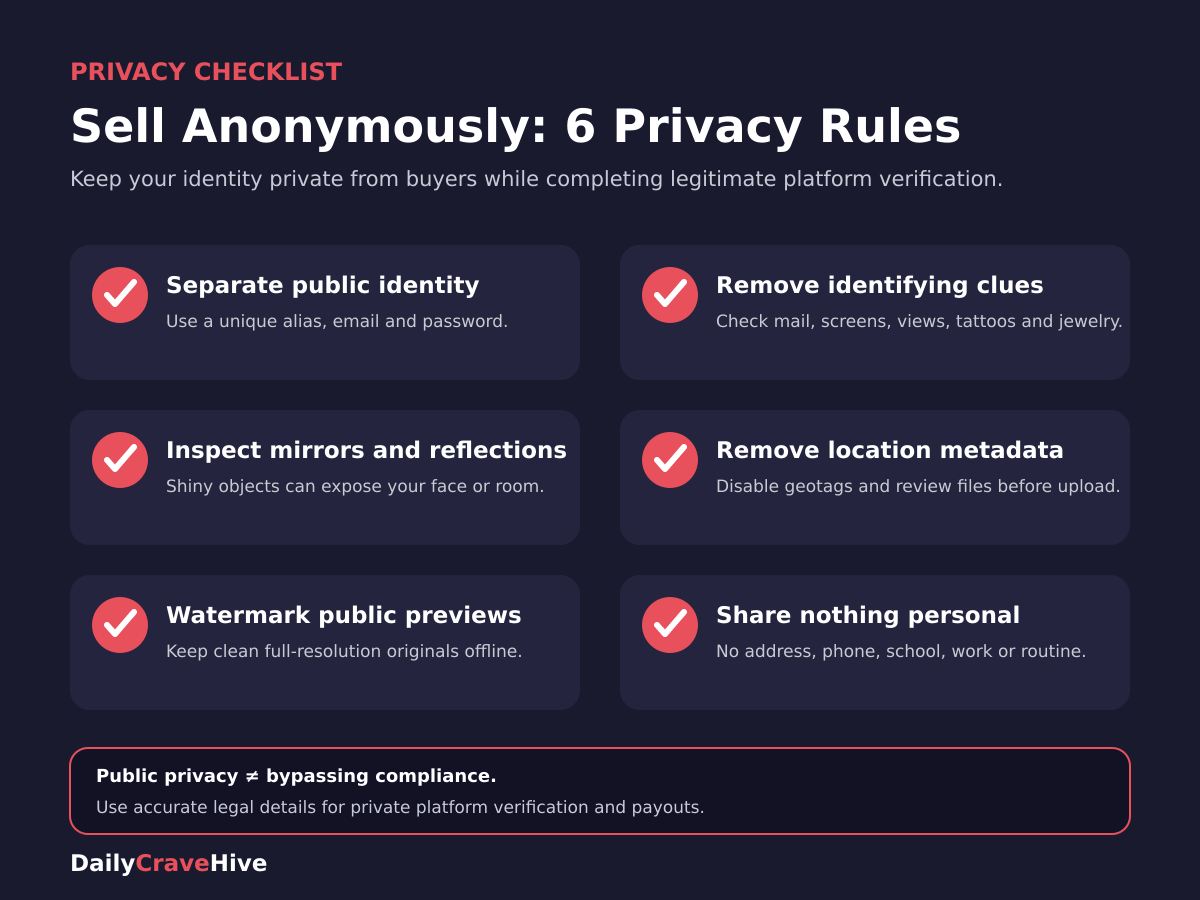
Use this checklist before your first upload:
- choose a creator name unrelated to your legal name;
- create a separate creator email;
- never reuse a personal profile photo;
- keep your face, name badges, documents, house numbers, mail and screens out of frame;
- watch mirrors and shiny surfaces for reflections;
- cover or avoid distinctive tattoos and identifying jewelry if anonymity matters to you;
- disable location tagging for new photos and remove location metadata before sharing;
- watermark public previews with your creator handle;
- keep clean, full-resolution originals offline;
- use different passwords and two-factor authentication;
- never share your home address, personal phone number, school, workplace, or daily routine with a buyer. Privacy is a process, not a checkbox. Check every new setup as if someone were trying to identify the room from the background.
The Simple Money Math: From First Sale to $100, $500 or $1,000
There is no honest formula that guarantees an income target. But planning math helps you see what a target would require.
Imagine your average order is $25 gross and your platform takes 15%. Your net before taxes and other costs is about $21.25 per order. Five such orders would produce about $106 before tax.
If your average order rises to $40 gross with the same 15% fee, you keep about $34 per order before tax. Roughly 15 orders would produce about $510 before tax.
If you eventually average $50 gross and keep 90% after a 10% service fee, you net about $45 per order before tax. Around 23 such orders would be about $1,035 before tax.
These are scenarios, not earnings forecasts. They show why improving average order value and repeat purchases can matter more than uploading hundreds of cheap individual photos.
Also remember taxes. In the United States, the IRS says gig-economy income must be reported even if it is part-time or you do not receive an information return, and self-employed gig workers may need to make estimated tax payments. If you live elsewhere, use your country's tax authority or a qualified local professional.
Common Beginner Mistakes That Kill First Sales
Four empty profiles are worse than one complete storefront. Avoid these common errors:
- Copying another seller: borrow the structure, not their identity, bio or content.
- Giving away the product: previews should prove quality, not replace the paid set.
- Hiding all prices: show a starter offer, bundle and custom starting point so buyers do not have to ask for everything.
- Ignoring fees: price from the amount you want to keep after the platform cut, not just the gross sale.
- Treating testimonials as averages: a success story can be genuine and still be unrepresentative of typical earnings.
- Ignoring promotion rules: a feet marketplace allowing a post does not mean every social network or community permits the same promotion.
- Accepting uncomfortable requests: decide your boundaries before the first buyer messages you and decline anything outside them.
Frequently Asked Questions
Can you really sell feet pics and make money?
Yes, legitimate marketplaces exist and creators do sell feet-focused digital content. But there is no guaranteed income. Your result depends on platform demand, competition, quality, pricing, discovery, response time, safety practices, and repeat buyers.
How do I sell feet pics for money as a complete beginner?
Choose one established marketplace, read its rules, complete required verification, create a separate public creator identity, shoot 15–20 quality photos, publish a small paid bundle and a custom option, and use watermarked previews. Keep the transaction on-platform and track what buyers actually click or purchase for two weeks before making major changes.
Where is the best place to sell feet pics?
For beginners, specialist marketplaces such as FeetFinder, FootLove, and Feetify are easier to compare than unmanaged social DMs because they are built around feet-content discovery. "Best" depends on the live fee, verification, payment protection, payout availability in your country, content rules, and your ability to attract buyers.
How much should a beginner charge for feet pics?
FeetFinder's July 2026 guide says observed listings commonly fell around $5–$20 per individual photo, $15–$40 per bundle, and $20–$75 for short videos. Use that as one marketplace reference, not a promise. A simple first test is a $15–$25 five-photo bundle, then adjust after real clicks, messages, and purchases.
Can I sell feet pics without showing my face?
Usually, yes. Your public content does not have to show your face simply because a private platform verification step needs your ID/selfie. Always follow the specific platform's rules. Keep identifying backgrounds, reflections, tattoos, names, and location data out of content if anonymity matters.
Can I sell feet pics for free?
Some platforms advertise free signup, but "free to join" is not always "free to sell." Feetify offers a free tier but pushes Premium selling features. FootLove advertises free signup while its terms reference Coins, subscriptions, and fees.
How do I sell feet pics without getting scammed?
Keep payments and order details on a reputable platform when possible, never send paid content before confirmed payment, never trust a payment screenshot, do not refund an alleged overpayment to a stranger, reject requests for gift cards or "release fees," and do not click verification/payment links sent by buyers. The FTC specifically warns online sellers about fake payments and overpayment scams.
Do I need social media followers to make a first sale?
No. A feet-specific marketplace can provide discovery without an existing following. However, safe and rule-compliant external promotion can add traffic. If you already have an audience, that can be especially useful on a platform where you are responsible for bringing more of your own buyers.
Do I have to pay tax on money from feet pics?
Tax law depends on your country. In the U.S., the IRS says gig-economy income is reportable even when it is part-time or no information return is issued. Keep records of revenue, platform fees, and relevant business expenses, and get professional advice for your situation.
How long does it take to make a first sale?
There is no reliable universal average. A strong profile can sell quickly, while another may not sell at all. Give one platform a structured 14-day test, track views/messages/orders, improve one variable at a time, and switch or add a marketplace only when the data gives you a reason.
Is selling feet pics passive income?
Not at the beginning. You have to create content, write listings, handle messages, monitor scams, deliver orders, promote safely, and keep records. A library of paid content can generate repeat sales later, but calling the whole process passive hides the work required to build and maintain it.
Final Verdict: The Smartest Beginner Strategy in 2026
If your goal is to sell feet pics and make money, do not start by chasing a monthly income number. Start by proving four smaller things: that you can create content you are comfortable selling, that a real buyer will pay for one clearly defined offer, that you can complete that transaction safely and professionally, and that you can learn from it and repeat the process.
Choose a platform whose current fees and rules you understand. Build two clear content lanes. Create one low-friction starter bundle, one better-value core bundle, and one custom option. Protect your identity, keep good records, use safe payments, and track conversion instead of vanity metrics.
That is less exciting than "upload a photo and make $500 tonight." It is also much closer to how a sustainable online side hustle actually works.
If you decide feet content is not the right fit, our Top 35 Money Making Ideas 2026 guide covers other online income models with different privacy, startup-cost, and skill requirements.
Alma MartinEditor, Daily Crave Hive
Alma Martin is the editor at Daily Crave Hive. She tests creator and adult platforms hands-on — fees, payouts, safety, and scam checks — so readers get honest reviews before they sign up. 18+.