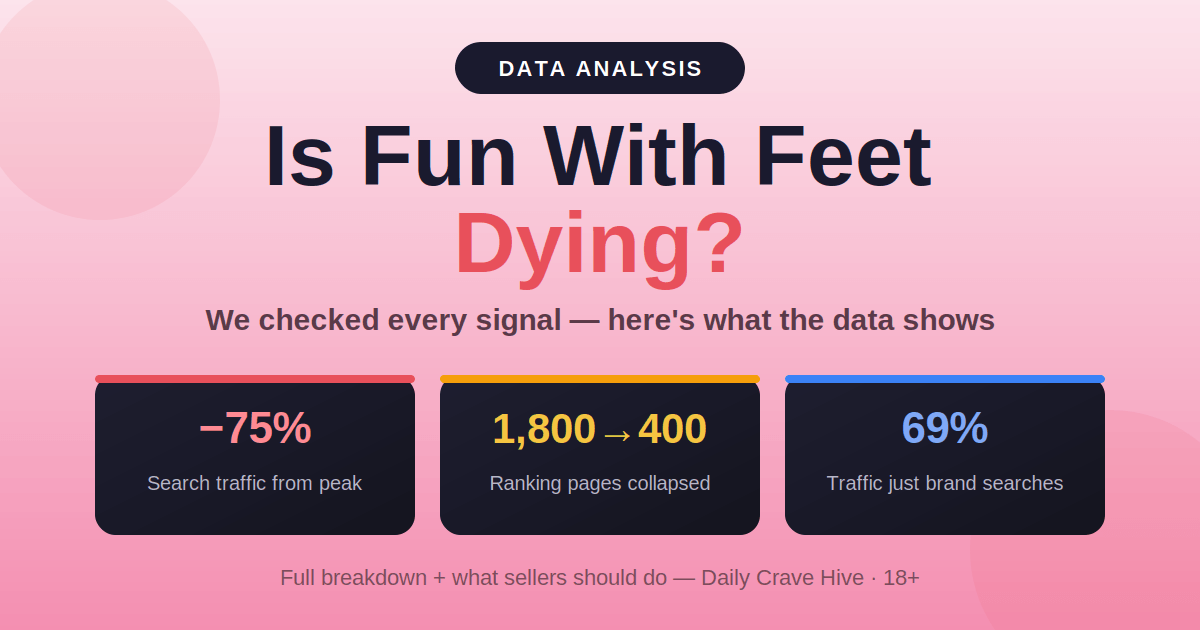
The short version: Fun With Feet is not dead — the site is online and taking signups. But across every signal we can measure from outside, it is shrinking: estimated search traffic down roughly 75% from its early-2025 peak, the number of pages it ranks with collapsed from around 1,800 to under 400, nearly 70% of its remaining traffic riding on brand-name searches alone, seller fees up 50%, and a steady stream of public complaints about logins, payouts and support.
One of these alone would be a bad quarter. All of them together are a trend — and if you're paying a monthly seller fee for access to this platform's buyers, that trend is your business too. Here's the full picture, factor by factor.
First, What "Dying" Would Even Mean
Platforms rarely die with an announcement. They fade: search visibility drops, new buyers stop discovering the site, sellers compete harder over a shrinking pool, complaints rise, and one day the marketplace is technically online but practically empty.
So instead of arguing about a word, we checked the measurable signals — traffic, ranking pages, traffic concentration, fees and public sentiment — and let them tell the story. Data below is from Ahrefs, a third-party SEO tool that estimates Google traffic; estimates aren't exact, but two-year trends don't lie about direction.
Signal 1: Search Traffic — Down ~75% From Peak
Search traffic is the first signal to check because, for a marketplace, it's the supply line of new buyers. People don't bookmark a feet-pic site the way they bookmark their bank — most arrive from Google.
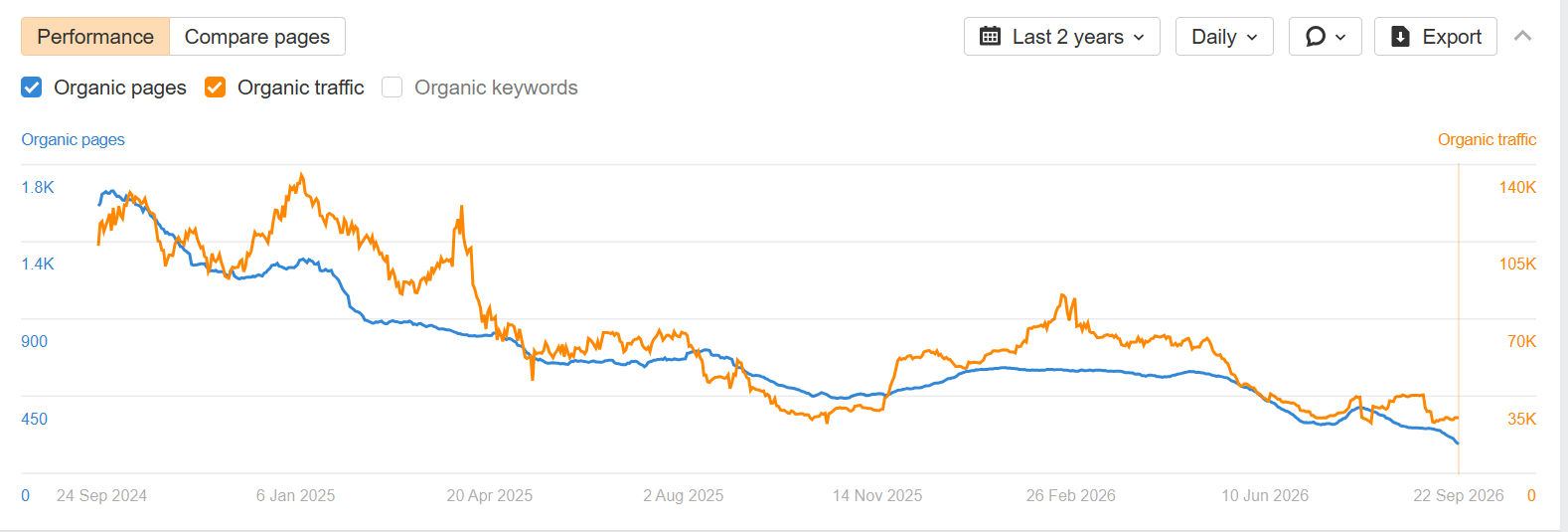
So when a platform's search traffic falls, its stream of fresh buyers falls with it, and every seller inside feels it eventually. Here's what that stream looks like over the last two years:
 Data: Ahrefs, September 2026
The two-year chart tells the story in three acts:
Data: Ahrefs, September 2026
The two-year chart tells the story in three acts:
- The big fall (2025): estimated organic traffic peaked around 140K monthly visits in early 2025, then slid to roughly 35–40K by late summer — about a 70% drop inside a year.
- The failed recovery (early 2026): traffic climbed back to around 70K by February–March 2026. Credit where due — that's a real recovery. It didn't hold.
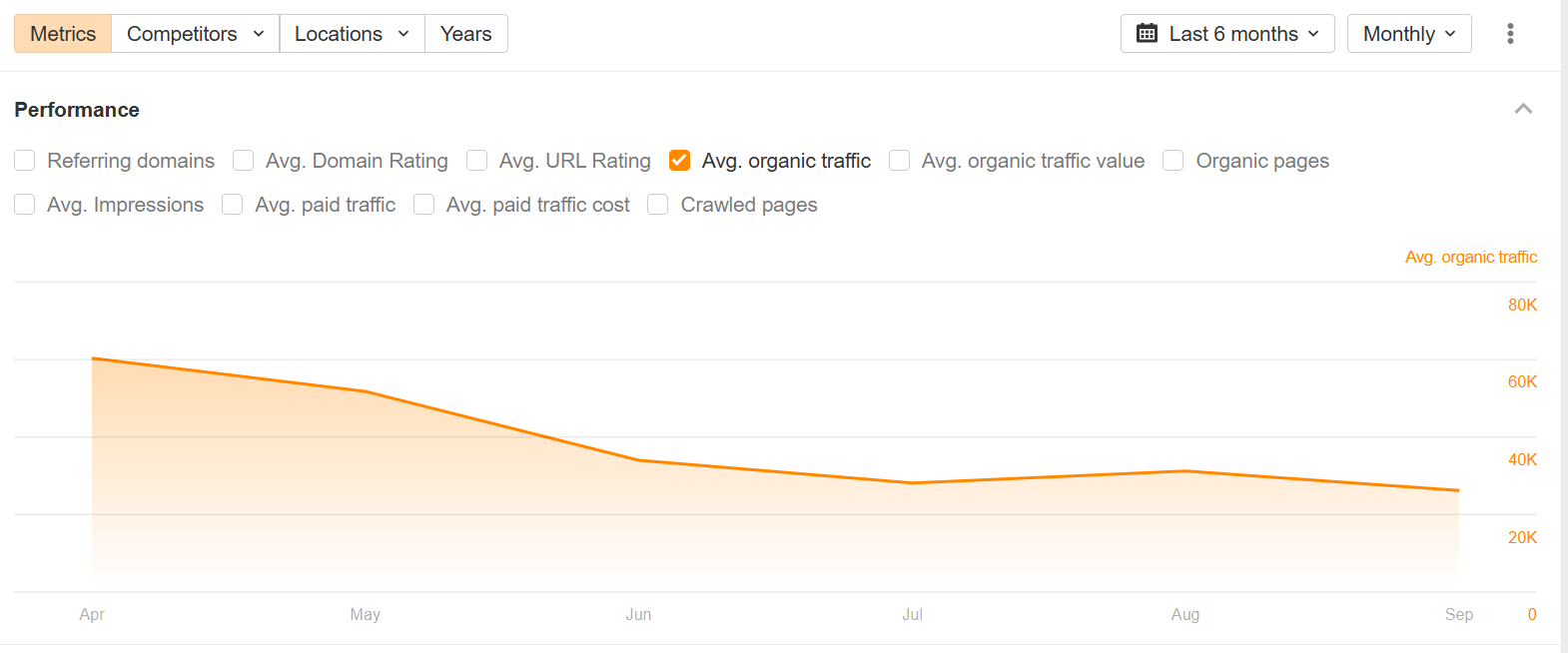
- The second decline (June 2026 onward): from mid-2026 traffic fell again, from about 65K to roughly 35K by September — another ~45% down in six months, right back at the previous floor.
 Data: Ahrefs, September 2026
A one-time drop can be an algorithm hiccup. Two waves in eighteen months, with a recovery that collapsed, is a pattern.
Signal 2: Ranking Pages — From ~1,800 to Under 400
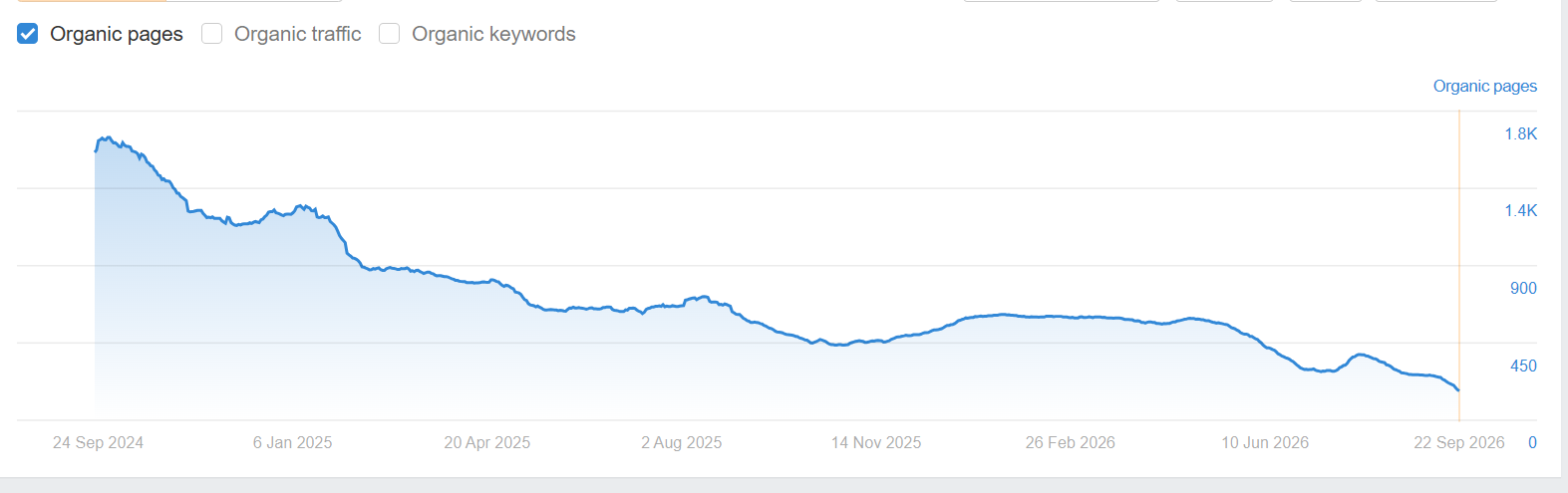
Traffic tells you how many visitors arrive; ranking pages tell you how much of the site Google still considers worth showing. A healthy site keeps hundreds of pages earning search visits — guides, comparisons, category pages — all pulling in different audiences. Watch what happened to that footprint:
 Data: Ahrefs, September 2026
Traffic can bounce with rankings. This number is scarier: the count of the site's pages that rank for anything at all has fallen from around 1,800 to under 400 — and the latest page-level report shows just 171 pages receiving any search traffic.
That means large parts of the site — especially its blog and informational content — have effectively dropped out of Google's useful index, whether devalued by Google's updates or removed by the site itself. Either way, the content machine that once pulled in new visitors has mostly stopped working.
Signal 3: The Remaining Traffic Is Mostly Just the Brand Name
Not all traffic is equal. Visits from people searching a site's own name are very different from visits won on open searches like "sell feet pics" — the first is old awareness being used up, the second is new demand being captured. So the mix of a site's traffic quietly reveals its health.
This is the detail most analyses would miss, and it's the most telling one: of the site's remaining ~25K monthly visits in the latest snapshot, the homepage alone takes 69%. The next biggest page — its "sell feet pics" landing page — takes another 14%. Everything else, including its entire blog, splits crumbs.
Why that matters: homepage-heavy traffic is mostly people who already know the site and search its name. It's not new demand being captured — it's existing awareness being spent. A healthy marketplace wins strangers from searches like "sell feet pics" and "best feet pic sites"; a fading one survives on people typing its own name. The data says Fun With Feet has largely become the second kind.
Signal 4: Fees Went Up While Visibility Went Down
The next signal isn't from an SEO tool — it's from the platform's own pricing page, and it matters because fees and traffic are two halves of one deal. Sellers pay a platform for access to its buyers; what happened to the price of that access while the buyer stream shrank?
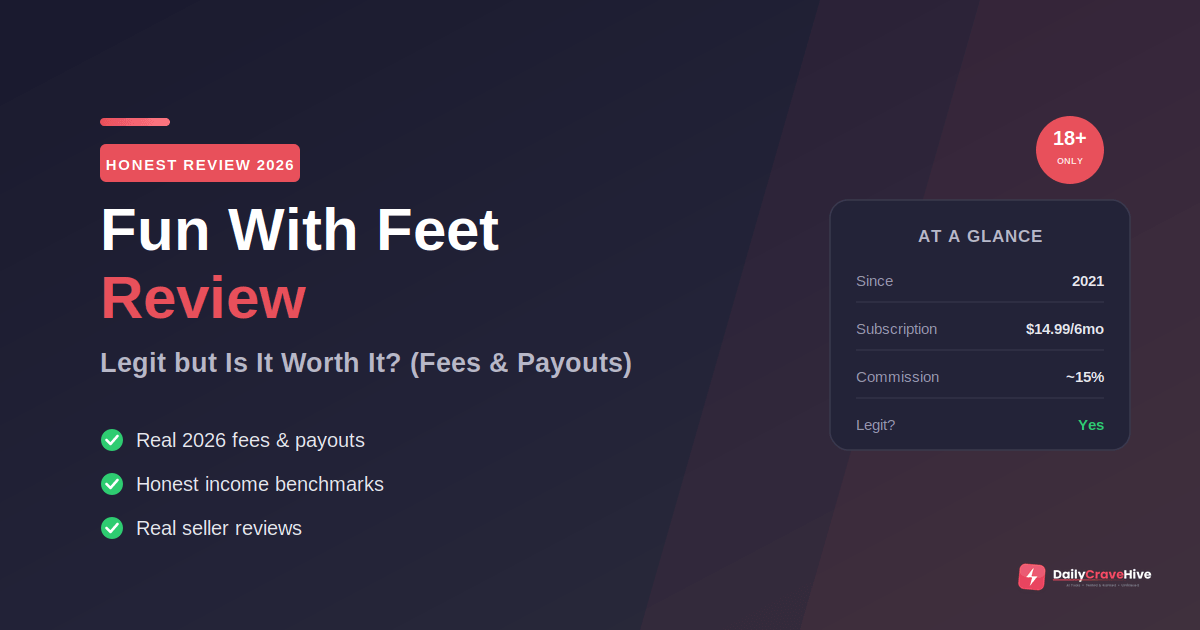
Through the same period, the seller subscription rose from $9.99 to $14.99 a month — about $180 a year at the monthly rate. There's nothing wrong with a platform raising prices. But raising the cost of a storefront while the mall's foot traffic drops 75% inverts the deal sellers signed up for: pay more, be seen by fewer buyers. That's the equation every current and prospective seller should be running.
Signal 5: What Public Reviews Show
Numbers describe what's happening; user reviews hint at why. On their own, reviews are the weakest of the five signals — small samples, angry-people bias — but when their pattern points the same direction as every chart above, they stop being noise and start being confirmation.
Recent public reviews show a consistent complaint pattern in 2026: users reporting they paid for subscriptions and then couldn't log in, cancellation attempts failing, support emails bouncing on both channels, payout friction around the platform's minimum, and being asked for additional payments after signup.
To be fair: unhappy users review more than happy ones everywhere, sample sizes are small, and the platform disputes fake reviews on its profile. But the direction of sentiment matches the direction of every other signal here — and Google increasingly folds real-world trust signals into rankings, which may be part of why the declines feed each other.
What Could Explain All This? (Labeled Speculation)
We can't see inside the company, so treat these as informed possibilities, not verdicts:
- Google's update cycle. Both decline waves loosely track Google's core update seasons, which have been brutal on thin content and low-authority pages since 2024. Losing three-quarters of your ranking pages is the classic post-update signature.
- Trust signals compounding. Fee hikes and support complaints don't just annoy sellers — they generate exactly the public negativity that modern ranking systems appear to weigh.
- Competition taking the queries. The feet-platform space is far more contested than in 2023. The informational searches Fun With Feet's blog once ranked for — selling guides, comparisons, "is X legit" — are now dominated by bigger content operations. Traffic lost in search is usually traffic won by someone else.
What we could NOT confirm: any shutdown, sale, or official statement about the decline. The site is online and operating as of this writing. If that changes, this page gets updated.
The Contrast: Not Every Feet Marketplace Is Shrinking
Here's the context that turns this from gossip into a decision: the decline is not industry-wide. Demand for feet content keeps growing, and the traffic leaving one platform flows to others. FeetFinder — the largest and most established feet marketplace — has held its position through the same period that Fun With Feet slid, with the bigger buyer base, active seller payouts, and the content visibility that keeps new buyers arriving.
That's precisely why it sits where it does in our platform rankings, and our full FeetFinder review breaks down its fees, payout proof and how to start there.
The lesson isn't "Fun With Feet bad, switch blindly." It's that platform choice is a moving target — and right now the data says the market's center of gravity is not where it was two years ago.
What Sellers Should Do (Practical, Not Panic)
- Run your own numbers first. Your dashboard beats any third-party chart. Are your sales and buyer messages there flat, growing, or shrinking over 6 months?
- Withdraw regularly. On any platform showing stress signals, don't let balances pile up — cross the minimum, cash out.
- Screenshot monthly. Balance, sales history, subscription payments. Costs nothing, settles every future dispute.
- Think hard before renewing. Weigh the ~$180/year math against your actual recent sales there — not against last year's.
- Diversify now, not after. One platform is one point of failure — that's the oldest lesson in this niche.
The Bottom Line: Declining, Not Dead
So — is Fun With Feet dying? It's not dead, and it may yet turn around. But every measurable outside signal points the same direction: search visibility down ~75% from peak with a second decline underway, ranking pages collapsed to a fraction, remaining traffic living off brand searches, fees up, complaints up. For buyers that's trivia.
For sellers paying monthly for access to this marketplace's buyers, it's a trend to plan around — and the plan is diversification while your income there still works. We'll keep this analysis updated as the data moves.
Frequently Asked Questions
Is Fun With Feet shutting down?
There's no evidence of a shutdown. The site is online and accepting signups as of this writing. What the data shows is a deep, sustained decline in search visibility — roughly 75% below its early-2025 peak — plus a collapse in ranking pages and rising public complaints. Declining and shutting down are different things; we'll update this page if the status changes.
Is Fun With Feet still active in 2026?
Yes — the platform is active and operating. But third-party estimates show its Google traffic at roughly a quarter of its early-2025 peak, with nearly 70% of remaining visits going to the homepage (mostly brand-name searches), which means far fewer new buyers are discovering the site than before.
Should I stop selling on Fun With Feet?
Not necessarily. If your personal sales there are steady, keep the working income — but stop relying on it alone. Withdraw earnings regularly, avoid long subscription commitments, and build a second platform (see our current rankings) so one site's decline can't zero your income. If you're a new seller choosing your first platform today, the data favors starting elsewhere.
Is Fun With Feet worth it in 2026?
For most new sellers, the math has gotten harder: the seller subscription rose to $14.99/month (~$180/year) while the platform's buyer-bringing search traffic fell about 75% from peak. Paying more for a smaller pool is a tough deal. Established sellers with repeat buyers there may still profit; new sellers should compare alternatives first — our full Fun With Feet review and platform rankings cover the current options.
Where does this data come from?
From Ahrefs, a widely used third-party SEO tool that estimates websites' Google traffic and rankings. Estimates aren't exact, but the two-year trend is clear: estimated traffic falling from ~140K monthly visits at peak to ~35K, ranking pages from ~1,800 to under 400, and heavy concentration of remaining traffic on the homepage. Charts with dates are included above.
Alma MartinEditor, Daily Crave Hive
Alma Martin is the editor at Daily Crave Hive. She tests creator and adult platforms hands-on — fees, payouts, safety, and scam checks — so readers get honest reviews before they sign up. 18+.