18+ Disclosure: This guide is for adults aged 18 or over who earn money legally from creator platforms. Some links may be affiliate links — we may earn a commission at no extra cost to you (see our affiliate disclosure). This is general information, not tax advice. Tax rules depend on where you live and your personal situation, so speak to a qualified tax professional before you file.
Last checked: October 27, 2026. What OnlyFans, FeetFinder and the IRS say about taxes on creator income.
Short answer: yes. If you earn money on OnlyFans, sell feet pics on a marketplace or get paid through any creator platform, that income is generally taxable. A lot of new creators find this out the hard way, usually in their first tax season, when they owe more than they expected.
This guide explains what the platforms themselves say about tax, and what the IRS says about self-employment income, tax forms and estimated payments. We re-checked OnlyFans' Terms of Service (the public page shows "Last updated: August 2024"), FeetFinder's Terms of Service (effective September 30, 2026) and official IRS pages on October 27, 2026. The main focus is the US, with a short section for creators elsewhere. Anything we couldn't confirm on an official page is labelled commonly reported. We're not accountants, and tax figures and thresholds change, so please check the official site of your tax authority.
Creator Taxes At A Glance (US)
| Question | Answer | Source |
|---|---|---|
| Is creator income taxable? | Yes, even if it's part-time or no form is issued | Confirmed (IRS Gig Economy Tax Center) |
| Who handles your tax? | You do, not the platform | Confirmed (OnlyFans and FeetFinder Terms) |
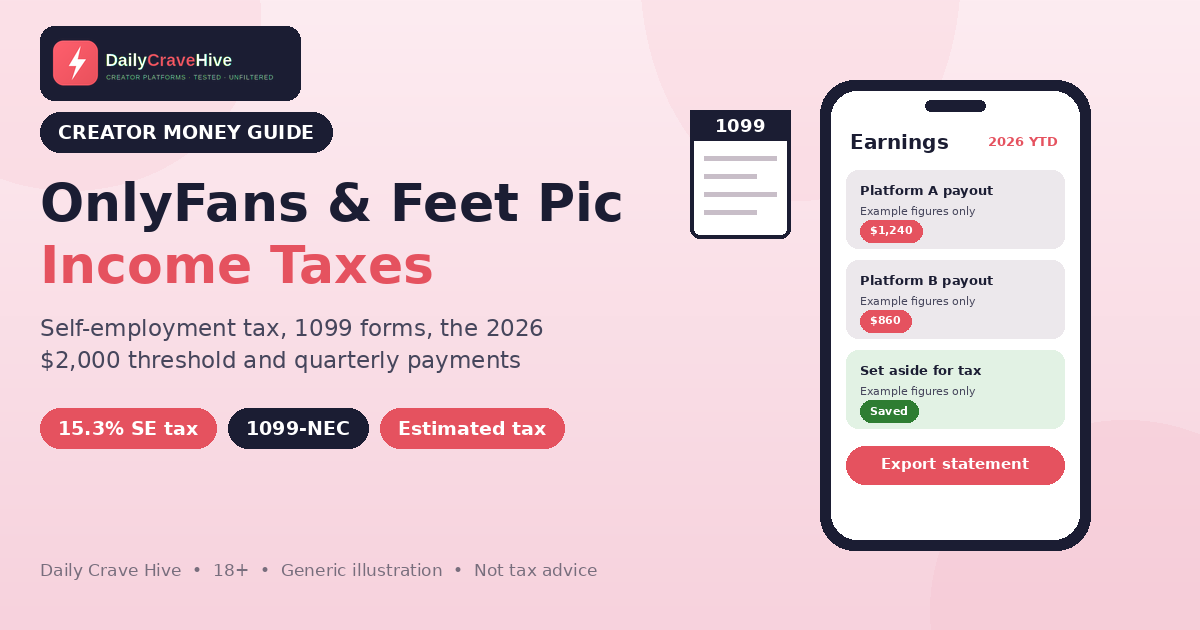
| Self-employment tax rate | 15.3% (12.4% Social Security + 2.9% Medicare) | Confirmed (IRS) |
| When you owe SE tax | Net self-employment earnings of $400 or more | Confirmed (IRS) |
| 1099-NEC threshold | $600 for payments before 2026; $2,000 for payments made in 2026 | Confirmed (IRS) |
| 1099-K threshold (apps/marketplaces) | Over $20,000 in more than 200 transactions (may be sent for less) | Confirmed (IRS) |
| Estimated taxes | Generally required if you expect to owe $1,000 or more; four payment periods a year | Confirmed (IRS) |
As checked on October 27, 2026. Check the official site, because thresholds may change.
What The Platforms Say
OnlyFans
OnlyFans' Terms of Service are clear: "Creators are responsible for their own Tax affairs." OnlyFans also says it isn't responsible for advising you on tax, or liable for any general tax information it provides. By using OnlyFans as a creator, you warrant that you have reported, and will report, "all payments you receive in connection with your use of OnlyFans to the relevant Tax authority in your jurisdiction, as required by law."
The Terms add: "You alone are responsible for ensuring that you make any necessary Tax fillings and pay any Tax due on your earnings on OnlyFans." They warn that failing to comply "may result in your OnlyFans account being closed or suspended." If you become tax non-compliant, or are named in an investigation that may lead to tax non-compliance, OnlyFans reserves the right to "close, restrict payouts from, or restrict earnings from your account." So tax isn't only an IRS issue. It can affect your account too.
OnlyFans' revised Terms are due to apply from November 1, 2026. As of October 27, 2026, the public Terms page still shows the August 2024 version quoted here, so check whether these clauses change after November 1.
OnlyFans also has a separate Tax Policy. We couldn't read the official page with our tools, so these details are commonly reported from copies of that policy:
- US creators submit a W-9 in the Banking section of their account
- Eligible creators can download Form 1099 from the same section
- The policy mentions a $600 threshold, which predates the IRS increase covered below
Check your own account and the official policy for current details. For what OnlyFans deducts before you're paid, see our OnlyFans fees and payouts guide. Your tax is worked out on what you actually earn, not on what fans paid.
FeetFinder And Other Marketplaces
Feet pic sellers are in the same position. FeetFinder's Terms of Service say: "Sellers are solely responsible for their own Tax affairs." They also say sellers have reported, and will continue to report, all earnings "to the appropriate Tax authorities in your jurisdiction." FeetFinder adds that it isn't responsible for giving tax guidance or ensuring your compliance. Our FeetFinder review covers how the platform's fees and payouts work.
Other platforms say much the same. Our Fansly review summarizes Fansly's tax forms and the fact that it doesn't withhold tax.
Is OnlyFans Or Feet Pic Income Taxable?
Yes. The IRS's Gig Economy Tax Center says you must report gig economy income on a tax return "even if the income is":
- "From part-time, temporary or side work"
- "Not reported on an information return form — like a Form 1099-K, 1099-MISC, 1099-NEC, W-2 or other income statement"
- "Paid in any form, including cash, property, goods, or virtual currency"
The IRS's list of gig work includes selling goods online and providing "creative or professional services," which is close to what creators do. So the common belief that you don't owe tax unless you get a 1099 is wrong. You owe tax on taxable income whether or not a form arrives.
That includes tips, pay-per-view messages, custom requests and referral earnings, as well as subscriptions. If it came to you through your creator business, treat it as income and ask a professional if you're unsure.
Self-Employment Tax: The Part That Surprises People
Most creators are independent contractors, not employees, so nobody withholds tax from their payouts. That's where self-employment tax comes in.
According to the IRS page on self-employment tax:
- "The self-employment tax rate is 15.3%," made up of "12.4% for social security" and "2.9% for Medicare."
- You must pay self-employment tax and file Schedule SE if "your net earnings from self-employment... were $400 or more."
- You can deduct the employer-equivalent portion of your SE tax when working out your adjusted gross income.
- The rules apply "no matter how old you are."
The same page says the Social Security part only applies up to a yearly earnings cap, and that higher earners may owe an additional 0.9% Medicare tax above certain thresholds (for example, $200,000 for single filers). Most new creators won't hit those limits, but bigger earners should know they exist.
Self-employment tax is on top of regular income tax. That's why it's commonly recommended that creators set aside a share of every payout for tax. Some creator guides suggest a fixed percentage, but there's no official figure that fits everyone. The right amount depends on your income, expenses and where you live, so ask a tax professional.
Tax Forms: 1099-NEC And 1099-K
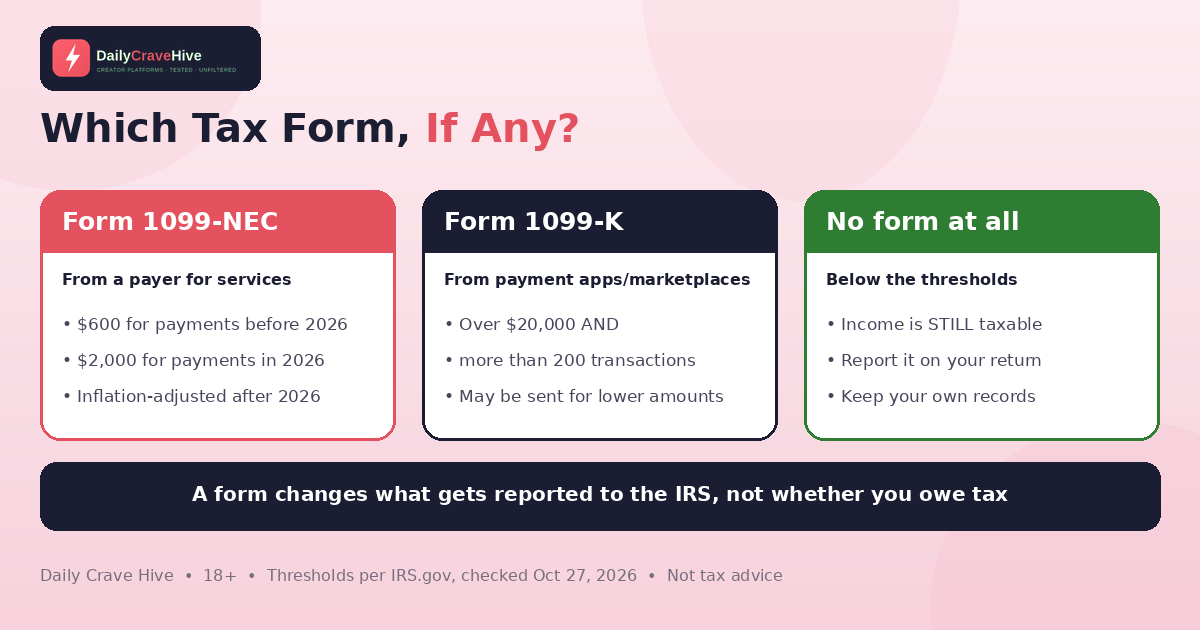
A tax form changes what gets reported to the IRS, not whether you owe tax. Illustration based on IRS pages.
Form 1099-NEC And The New $2,000 Threshold
The IRS page "Am I required to file a Form 1099 or other information return?" says: "For payments made before 2026, the reporting threshold is $600. For payments made in 2026, the reporting threshold is $2,000." For payments after 2026, the IRS says to check Publication 1099 for the inflation-adjusted threshold.
What this means for creators:
- For 2025 income, filed in early 2026, the old $600 threshold applied
- For 2026 income, filed in early 2027, a payer generally only has to issue a 1099-NEC once payments reach the $2,000 threshold
- Either way, you still report all your income, including amounts below the threshold
Conflicting figures: the $600 figure that's commonly reported in OnlyFans' Tax Policy matches the old IRS rule, not the $2,000 threshold for 2026 payments. The IRS figure is the official one. A platform can still choose to send you a form below the threshold, and it doesn't change what you owe.
Form 1099-K
Some payments go through payment apps or online marketplaces. The IRS page Understanding your Form 1099-K says these must send one "if the payments you received for goods or services total over $20,000 in more than 200 transactions. However, they may send you a Form 1099-K with lower amounts and/or transactions." If you use several platforms, you could get more than one.
Which form you get, if any, depends on how a platform pays you. Don't count the same income twice if it appears on more than one form, and keep records so you can reconcile them.
Where To Find Your Forms
- OnlyFans: commonly reported to be in the Banking or Statements area of your account
- Other platforms: check your account's tax or payout settings, and your email (including spam) in January. The IRS says payment apps and marketplaces must send your 1099-K copy by January 31.
Estimated Taxes
Because nothing is withheld, the IRS says self-employed people "may have to file Estimated Taxes quarterly." According to its estimated tax FAQ, you generally have to make estimated payments if you expect to owe at least $1,000 in tax for the year after withholding and refundable credits, and your withholding and credits will be less than the smaller of 90% of this year's tax or 100% of last year's tax (110% if last year's adjusted gross income was over $150,000).
The IRS splits the year into four payment periods:
| Income earned | Payment due |
|---|---|
| January 1 – March 31 | April 15 |
| April 1 – May 31 | June 15 |
| June 1 – August 31 | September 15 |
| September 1 – December 31 | January 15 of the following year |
If a due date falls on a weekend or legal holiday, the IRS says the payment is on time if it's made on the next business day. If you don't pay enough by each due date, "you may be charged a penalty even if you're due a refund" when you file. Form 1040-ES and Publication 505 explain how to work out what to pay.
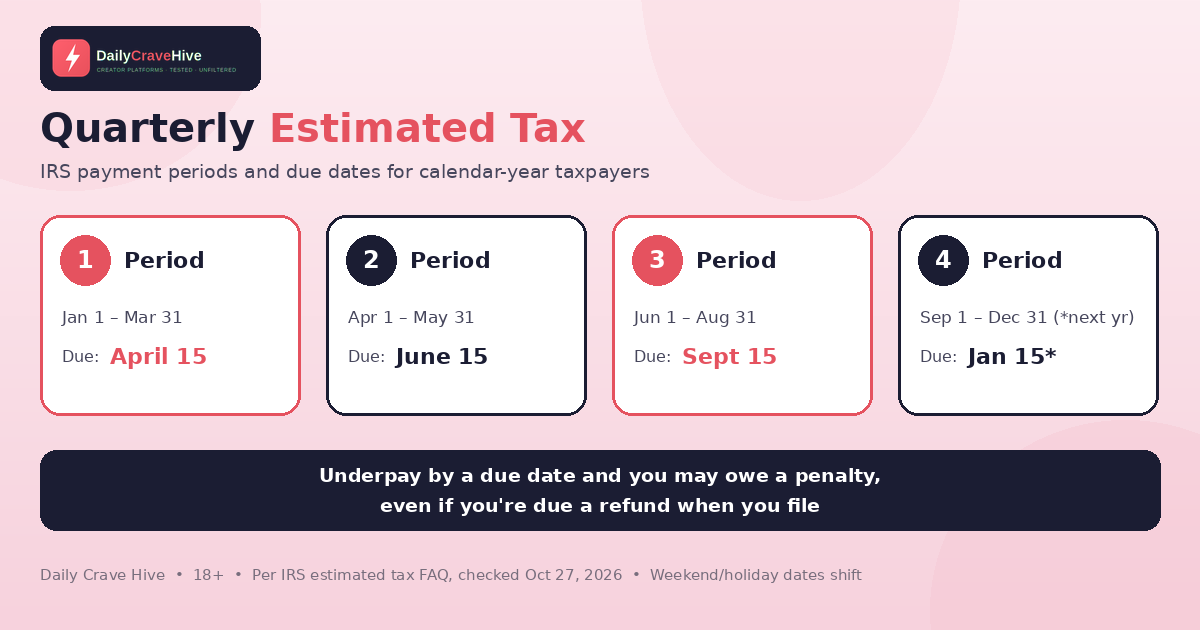
Estimated tax is paid in four instalments for calendar-year taxpayers. Illustration based on the IRS estimated tax FAQ.
Deductions: What Creators Commonly Claim
Self-employed people generally report business income and expenses on Schedule C, and the IRS says sole proprietors and independent contractors generally use Schedule C to work out net earnings from self-employment. That net figure is what self-employment tax is based on, so keeping track of real business costs matters.
Creators commonly report claiming ordinary and necessary business costs, such as:
- Platform plans or subscription fees (for example, a FeetFinder seller plan)
- Equipment such as cameras, lighting and phone accessories, depending on how they're used
- Props, outfits and nail or foot-care products used only for content
- Editing software and apps
- Part of your phone and internet bill used for the business
- Paid promotion within platform rules
Whether something counts as a deduction depends on the rules and your facts. Keep receipts, and check with a tax professional before claiming anything. Platform fees are usually taken before payout, so check whether your income figure is gross or net, and don't deduct a fee you were never paid in the first place.
Records To Keep
Good records make filing easier and help if anything is ever questioned:
- Monthly earnings statements from each platform
- Tax forms (1099-NEC, 1099-K) and the W-9 or W-8BEN you submitted
- Receipts for every business expense
- Bank records of payouts
- Records of any estimated tax payments
A simple spreadsheet with the date, platform, gross amount, fees and net payout for every month is enough to start. For a sense of what feet pic sellers actually take home after costs, see our guide to how much money you can make selling feet pics.
If You're Outside The US
Rules differ from country to country. OnlyFans' Terms say creators must report income "to the relevant Tax authority in your jurisdiction." Creators registered for UK VAT must follow OnlyFans' UK VAT Policy, and creators registered in an EU country must follow the EU VAT rules that apply. Non-US creators are commonly reported to be asked for a W-8BEN form instead of a W-9. Check your own tax authority's guidance and ask a local professional.
Frequently Asked Questions
Do you have to pay taxes on OnlyFans income?
Yes. The IRS says gig economy income must be reported even if it's part-time or no tax form is issued, and OnlyFans' Terms say creators are responsible for their own tax.
Do I pay tax on feet pic sales?
Generally, yes. Feet pic income is treated like other self-employment income. FeetFinder's Terms say sellers are solely responsible for their own tax and must report their earnings.
What is the 1099 threshold for OnlyFans in 2026?
According to the IRS, the Form 1099-NEC reporting threshold is $2,000 for payments made in 2026, up from $600 before 2026. You must still report all your income even if you don't receive a form.
How much self-employment tax do creators pay?
The IRS says the self-employment tax rate is 15.3%, made up of 12.4% Social Security and 2.9% Medicare. It applies if your net self-employment earnings are $400 or more, on top of income tax.
Do OnlyFans creators need to pay estimated taxes?
Many do. The IRS says you generally must make estimated payments if you expect to owe at least $1,000 for the year, and you can face penalties for underpaying, even if you're due a refund.
Can tax problems affect my OnlyFans account?
Yes. OnlyFans' Terms say tax non-compliance may lead to your account being closed or suspended, and OnlyFans reserves the right to restrict payouts or earnings.
What can creators deduct?
Creators commonly claim ordinary and necessary business costs such as equipment, props, software and platform plans. Rules depend on your circumstances, so keep receipts and check with a tax professional.
Final Thoughts
Creator income is taxable, and the platforms make it clear that tax is your responsibility. Save part of every payout, keep good records, pay estimated tax where needed, and don't assume no form means no tax. The 2026 change to the 1099-NEC threshold changes when you get a form, not what you owe. Check the official IRS site, or your own tax authority's site, and get professional advice.
Last checked: October 27, 2026. This guide is for adults aged 18 and over. This is not tax advice.
Alma MartinEditor, Daily Crave Hive
Alma Martin is the editor at Daily Crave Hive. She reviews creator and adult platforms - fees, payouts, safety and more - so readers get honest guides before they sign up.